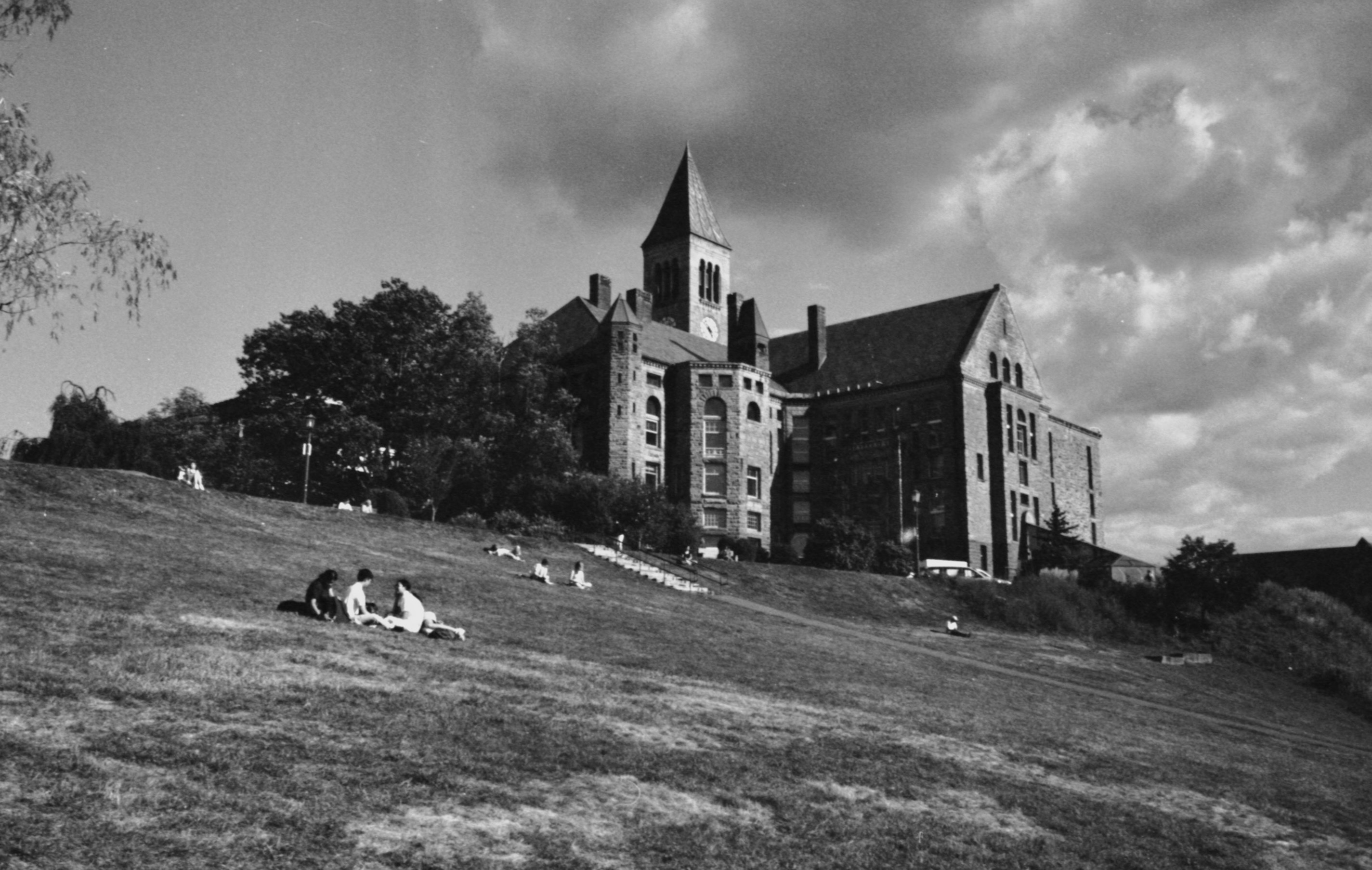
These young adults have the capacity to destroy each other. There are media crews prowling campus reporting on this very fact. For the last week, our community has been near-constantly deliberating the alleged rape enacted by seven of our peers upon another in 2024.
The media storm has exhausted and debilitated the people around me. Students in leadership roles are attempting to organize as stakeholders scramble to protect themselves; public figures are backing out of speaking events at Cornell, the university administration is locking down social media accounts, and all fraternity parties this weekend are cancelled.
Many of the women I know feel profoundly unsafe on campus among their male peers. Several have had difficulty leaving their apartment to go to class because campus is saturated with distress. My friends cannot focus on their homework or sleep soundly. Everyone is asking each other how are you doing and there is never a true answer that does not involve tears. For survivors, of which there are thousands on this campus, this week has brought upon a renegotiation with the circumstances and outcomes of their own traumatic experience, a constant retraumatization.
There is no effort from this university’s administration to manage this cataclysm. The university seeks to protect itself, just as it did two years ago.
An event like this begets a crisis of meaning. The “Cornell 7” story is an existential threat to this community, one that emphasizes the most horrific acts committed by students upon each other, and has drawn international attention to this remote, wayward campus.
At the same time—at this very moment—there is an opportunity to reclaim and redefine the Cornell narrative. This can only be done through action.
Cereese Qusba, Varsha Bhargava, Kate Turk, Mary Caitlin Cronin, Atticus Johnson, Coral Platt, Giselle Redmond, Shubha Gautam, Everett Chambala, Sophia Dasser, Sophia Romanov Imber, Zara Cheek, and Rayen Zhou are just some of the students at The Cornell Daily Sun diligently working on this unfolding story. They are going to bat with very powerful people and face enormous, overwhelming scrutiny. Meanwhile, Students for a Democratic Cornell, Cornell Planned Parenthood Generation Action, the ACLU Chapter at Cornell, Cornell Gender Justice Advocacy Coalition, and many other student groups are organizing to demand change from Cornell administration.
Beyond these visible, admirable efforts, I have seen enormous strength across Cornell’s mosaic social world. Thousands of students and faculty are attempting to build change and support each other interpersonally.
My friend in an executive position at her sorority has been holding “office hours” for members to stop by and chat. She is also trying to organize a safety committee to protect the women under her watch. The women on the executive board of a large student group created a resolution of desired action items to make their events safer for women. Art students are hosting a potluck dinner to make protest posters. Last night, I sat with the president of a male-dominated club as he took notes on the suggestions of female members.
My professor brought phone tags to lecture on Thursday that would allow students to track and reclaim their devices if lost, and offered us the opportunity to take a free self-defense class with the Ithaca Police Department. My friend’s professor offered a later date for a preliminary exam supposed to happen this week.
On Wednesday, a woman attempted to jump off of the Stewart Avenue bridge in lower Collegetown. She was stopped by a Cornell student.
A close male friend and I talked for several hours about rape culture. He began to understand. Several days ago, my friend texted a Sun reporter to thank her for work. Later, the reporter told her, “You texted me right before I went on CNN. It was exactly what I needed to see at that moment.”
Last year, I was sexually assaulted by another Cornell student. The perpetrator told me, “You do not belong here.”
I did not understand what had occurred until a friend noticed my vacantness and pushed me to share, after which he identified what had happened to me as assault. My other friends removed the perpetrator from the party. In the days following, I talked and cried at length with the women around me. I was replenished with abundant and unconditional love.
I recognized that I had been lied to; I do belong here. I want every survivor on this campus to feel the same, to recognize that they are a meaningful, fundamental part of our community, to feel loved and respected and safe again. I want the students at this school to take notice to the power and love that exists here, and strengthen it to wield against violence and injustice.
We, Cornell students, bear the responsibility of healing our community. We also bear the anguish of what has happened before us and what is happening now, and the uncertainty of what will happen next. Let’s try building something better. We are all we have.

Keep your digital safety in mind. If you have been on camera, or your name has been attached to any reportage, be mindful of any public personal information; audit your digital footprint and protect your privacy. The Online Harassment Field Manual has many resources for managing your digital security and responding to harassment.
Safety also means protecting yourself and your loved ones against sexual violence. Sexual assault education is not optional. 13% of undergraduate students experience sexual violence during college; this figure represents 26% of women and 7% of men. It is very likely that, at some point in college, you will directly contend with sexual violence. When this happens, the swiftness and confidence with which you act will make a meaningful difference.
The details of identifying, understanding, and reacting to sexual assault are beyond the scope of this piece, but there are many helpful resources for this online and within the Cornell and Ithaca community. For a first pass at understanding the basics of sexual assault, the Rape, Abuse, and Incest National Network (RAINN) has an excellent article, as well as myriad resources on prevention, statistics, and other essential information on their website.
Cornell’s Sexual Harassment & Assault - Response and Education (SHARE) office offers educational resources, as well as sexual assault services and resources for support after victimization. Cornell Health offers a guide on what to do when your friend is sexually assaulted. Despite Cornell University’s administrative failures, there are many competent, caring people working within these programs, and you should not hesitate to seek support during an emergency if Cornell Health is your most accessible option.
If you don’t want to seek help or resources through the university, the Tompkins County Advocacy Center offers 24/7 sexual assault support services free of charge, while RAINN operates a free 24/7 hotline. Cayuga Medical Center offers free SAFE exams (rape kit/forensic exam) 24/7, which can collect forensic evidence and provide medical attention. Generally, DNA evidence can be collected until up to 72 hours after the assault, and evidence is best preserved if you avoid cleaning yourself between the assault and the exam. Read more about SAFE exams here.
You cannot hope to remedy Cornell’s community as a whole. What you can do is identify your immediate community—your friends, teammates, classmates, club members, research group, project team, et cetera—and help ensure your wellness as a group.
Tend to physical wellness. You should be getting enough sleep and taking care of your body if you get sick. Your mental health is another priority. If you are a survivor, this week has probably been relentlessly, enervatingly difficult, and potentially retraumatizing. You do not have to endure this alone. Surround yourself with people that you trust.
If you are friends with a survivor, they may appreciate you reaching out. Even if you are not a survivor, or don’t know any survivors, check in with yourself and the people around you.
Cornell Health offers services through their Counseling and Psychological Services (CAPS); drop-in and group counseling is free, while short-term individual counseling is $10/session. To initiate longer-term care, you can schedule a free 25-minute access appointment. There are also mental health resources within Tompkins County, including 24/7 helplines and medical care, and the Whole Health Mental Health Clinic has Open Access Hours for walk-in treatment at certain hours on weekdays.
There are many beautiful places to reflect on campus (the Botanic Gardens, Beebe Lake, the Slope), and there are many beautiful ways to spend your time (outdoor activities, like apple-picking or biking or hiking; creating, writing, painting, sewing, cooking; going to Cornell Cinema, reading a library book, exploring Ithaca, going to a student group performance or event, et cetera). The Mid-Autumn Festival is tonight on Ho Plaza, and there will be free food and dancing.
The Cornell Daily Sun and many other media outlets have thoroughly summarized the events and ambiguity surrounding Cornell’s response to the alleged gang rape committed by Matthew Ingalls, Johnathan Newell, Winston Lee, Gillio Lopes, Diego Sarabia, Scott Norris, and Scott Kretzschmar. Stay informed. Understand the facts of the case and the university’s response thus far, so you can confidently and independently decide how you will respond. Donate to the Sun, if you can; send tips, or submit your own story; and keep reading the newspaper.
Students for a Democratic Cornell (SDC) is a prominent student group fighting for administrative reform, while Planned Parenthood Generation Action (PPGA) is mobilizing towards sexual assault prevention. If you want to get involved, these are good places to start. Keep in touch with their social media to see where and when you can show up to make your voice heard. Within your own organizations, elevate the voices of women and survivors and set tangible, actionable goals for the future.
Go to the Justice for Survivors rally on Monday, October 5th, at 4:30 p.m. on Ho Plaza. The organizers are demanding “Cornell to expel or revoke the degrees of all perpetrators complicit in the gang rape of Jane Doe”, as well as the revision of Cornell’s policies and procedures regarding sexual assault. If you agree with these goals, it is very important that you show up to contribute your voice to the many clamoring for administrative change.
Look out over the enormous gorges that divide Cornell from the rest of the world. This is all we have; this is our campus, our school, and our home. It is worth fighting for a better future here. It is imperative that we do.