He was thinking back on his final semester at Cornell. “Batman had a very good last semester, but Bruce Wayne, not so much,” he allowed sparingly. “It was bad. I was in a bad state.”
It was in the spring of his senior year that the Cornell Batman went through some shit. In short order, he dealt with death and grief. Then he felt love and faced rejection. He experienced loss.
His troubles made him feel so bad he started to “question everything.” It amounted to an infection that inflamed all his underlying worries. Why was he doing it? What was it all for? When he graduated, would he be remembered?
They were good questions, but he had trouble finding answers.
One day that spring, he got one.
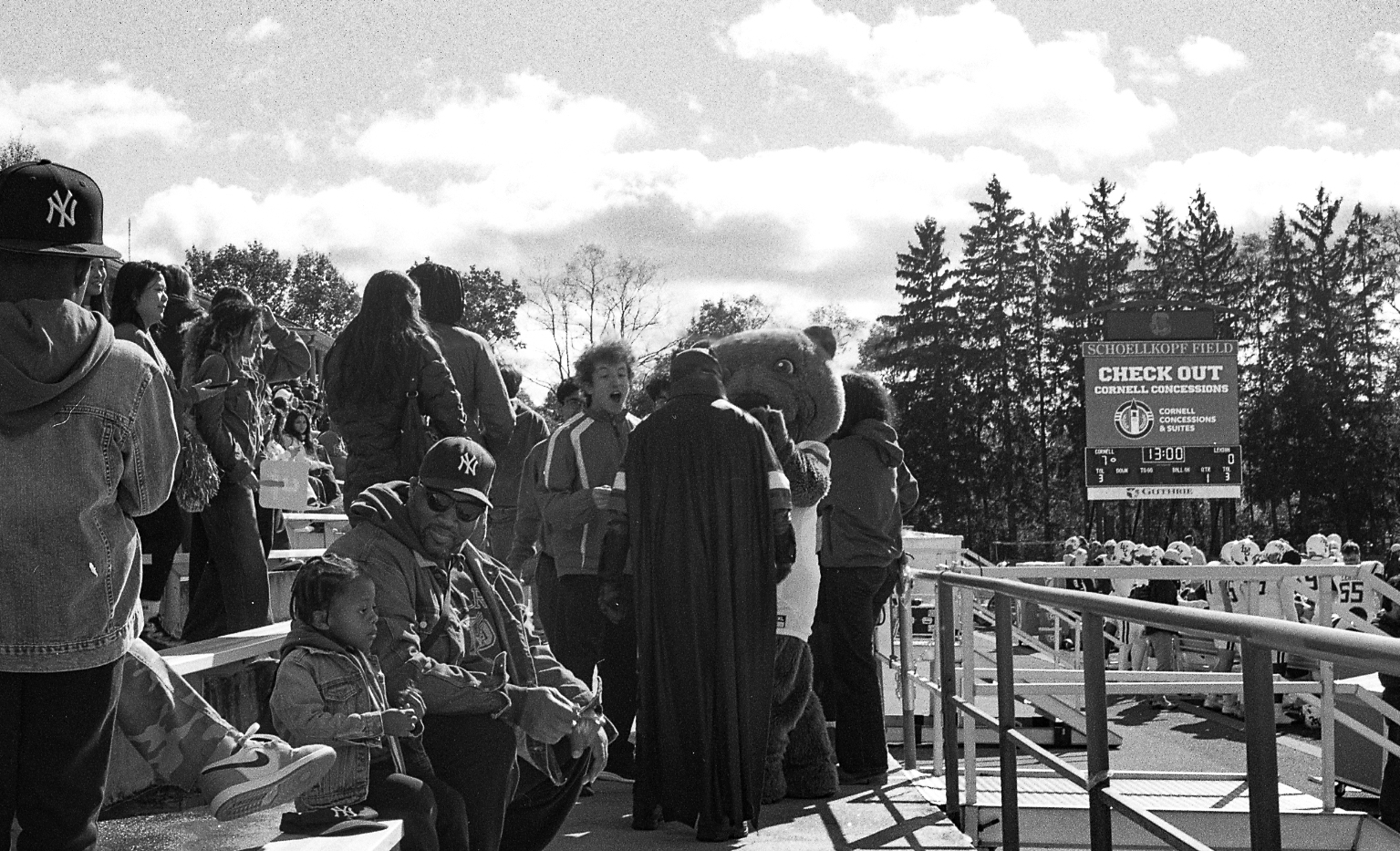
A child approached him at a basketball game and asked him for a picture. There was a public safety official standing next to him. The guy chimed in: “See that?” he said to Batman, “I don’t think you’re ever gonna be forgotten.”
That’s how the Batman remembers it: one emblematic episode of the “coolest shit I’ve ever done in my entire life.” As the horns blew and the bass boomed, as the cymbals blared and the electric guitars ripped into his headphones at 3 o’clock that September night, he felt “so good.” He realized, “I lived through all that tear-jerking shit and I’m still here.”
His neighborhood was quiet and his family was supportive, but he found his new reality harsher than his college years. "The real world is not nearly forgiving or hand-holding,” he said. “There’s no one to tell us what comes next.” It must have reminded him of why he became Cornell Batman in the first place.
Four years ago, Bruce Wayne thought he was a nobody. He didn’t know who he was or what he stood for—just that he wanted a purpose in life and wanted to matter. When Bruce Wayne became the Cornell Batman, he found what had eluded him, and he became himself. Now, beyond graduation, without the cowl, who was he?
As he looked back upon being the Batman, he said that “it was the greatest experience I’ve ever had in my life.” He admitted, “I don’t think anything is gonna beat it.”
By the time September came around, he missed his friends and wanted to come back. Then The Cornell Daily Sun broke the news and he decided he needed to come back.
The news, covered extensively by local, national, and international press, had brought outrage, pain, and trauma to Ithaca, New York. A group of men had allegedly drugged and raped a former student, and the Batman’s community was reeling in the fallout. He followed the horrific reports, the protests, the response from the university administration, the calls for resignations and justice and reform. He watched from afar, as if from that quiet, white, rich, suburb in Greater Gotham, he saw a bat-signal he could not respond to.
“I wanna get back into the suit, get back onto the streets, and get back to work,” he decided. “I want to suit up, walk around, and tell everyone it’s gonna be okay.” He had a line from Christopher Nolan’s The Dark Knight in mind: “The night is darkest just before the dawn. And I promise you, the dawn is coming.” He needed Cornell students to know, “It will get better.”
He needed to journey home to Ithaca. “Gotham loves a comeback story,” he said. “It’s not over.” He said “it’s just a different chapter.”’
Two years ago, I met a man in a Batman costume on Halloween. I wondered if he was hiding behind a mask or performing some extraverted stunt. I wondered if he was noble or misguided or bored. I never saw the man’s face and never learned his name—I didn’t want to. I always called him Batman and he, in that signature stern voice, called me Mr. Fuller. I know now that this decorum meant I respected him and what he stood for, that I even admired him. He was Batman, not just some dude in a costume. And he was also someone searching for a purpose, searching for meaning and a legacy, someone searching for himself.
He picked me up from where I stood at the 111st station in Queens. From the Batmobile, the man looked at me with large, glossy eyes, and despite having interviewed him and written about him and kept tabs on him for years, those eyes were the eyes of a stranger. He wore rectangular glasses and bore a widow’s peak amidst spikey brown hair. His body was thin and tough—like a high school wrestler’s. He wore a pair of Cornell basketball shorts.
Batman’s normal voice is not far from the one he uses when he suits up; it is rough, boisterous, and raspy. When I first interviewed him two years ago, I thought his gravitas was mostly an act. But Batman—under the mask—is a man of conviction. Since the alleged gangrape in a fraternity house at Cornell had been publicized, he had started a fundraiser for the Advocacy Center of Tompkins County, which serves survivors of sexual assault. When I met up with him in Gotham, he had raised 300 dollars.
When he spoke about the fundraiser, he carried a tightness with him. His body seemed strained and his posture in the front seat was completely straight. His fingers were thin, muscular, and tense. Every now and then, a vein flashed along his neck or arm.
He eased slightly when Commissioner Gordon, who was sitting in the back seat, brought up the good-ole days. “We gotta run it back,” agreed Batman. He was talking about the Chili’s in Ithaca.
Gordon, like Batman, was hard-spoken and stiff; he sat in the back seat. The two had been friends since one night when the Batman ventured into the gaming lounge at Cornell, and Gordon asked him to play Madden. Then Gordon began helping with the Batman’s image, publicity, and would even assist him when putting on his advanced suit. There was a running joke that Gordon lost everything: he misplaced keys, lost headphones, even left behind a whole pair of shoes at someone’s house. There was also a running joke about how bad he was at fantasy football. And given he was big-boned and Southern, there was another running joke that named him an ambassador for Bojangles, the South Carolinian fast-food chain.
Alfred liked that one. As we made for the city limits, he was doing homework on his laptop in the back seat. Alfred was soft-spoken, self-deprecating, and loved to sneak in a joke. He needed to submit a marketing presentation, and asked Gordon—who had taken the class before—to send him some answers: “Not gonna lie, I’m probably gonna Chat the whole thing. But can you send them to me?”
Gordon said no and Alfred got started on the whole Bojangles thing. “I don’t wanna show too much emotion,” said Gordon, flatly, “because I know it’ll just make it worse.” Gordon didn’t really like being the ambassador of Bojangles. He had recently taken a liking to Panera.
Alfred: “Panera?! What are you?!”
Gordon: “Yeah, I’m trying to eat a little healthier…”
We were now nearing the George Washington Bridge. Batman could see the water, a port, the skyscrapers, all the cars… “The city is always gorgeous,” he said to himself, “no matter where, no matter when.”
As he drove, the Batman was thinking back on a day in April. The Cornell Student Assembly had officially recognized him. They thanked him, declared that his impact would be long remembered, and wished that he would come back one day.
We were now leaving the city behind, speeding to the interstate. “That’s my home,” Batman said. “I made myself part of it—and its history.” He was not talking about the suburbs. “It’ll always be my home.” He was thinking about Ithaca.
It did not.
We turned off at an exit outside of Gotham. Alfred took control of the Apple CarPlay and, judging by his music choices, was in his feels. He called it his romance music; Gordon called it “White R&B.” Alfred said, about himself, “This is what almost 21 years of celibacy looks like.” On our way into the WaWa, he took his laptop with him.
I strolled the aisles, got some coffee, and picked out a few snacks. Alfred was perched on an unused checkout counter, his head in his computer. He wasn’t planning on buying anything because he’s got this thing… a super-fast digestive system that only allows him 30 minutes to an hour before he’s got to use the bathroom… so no snacks for Alfred. But Batman got a burger—and would’ve gotten some coffee, too, but the stuff goes right through him, he mentioned. Batman filled up the gas tank and we turned out of the lot. Then he asked, “You guys all used the bathroom before we left if you needed to?”
And yet, Cornell Batman is also just a dude in a costume. He’s a dude that likes anime, is a big fan of Lil Nas X, and missed the molten lava cake at Chili’s. He’s a dude who was troubled by his normalcy and frightened by transitions, who seeks self-discovery and aspires for transformation. In short, he’s a dude who wants to be more than a dude.
“Why would someone dislike the Cornell Batman?” I asked him.
“Your guess is as good as mine,” he said. “I can be a little campy sometimes. But it’s harmless fun and does good for the world—because the world is just unforgiving and harsh sometimes.”
Batman asked Albert to play “Alive” from the Jekyll and Hyde musical. It was his favorite song, one he had memorized and performed in a theatre showcase in high school. He belted out the lyrics:
I have a thirst
That I cannot deprive
Never have I felt so alive!
There is no battle
I couldn't survive
Feeling like this
Feeling alive!
When he was done, he was out of breath. It was the happiest I had ever seen him.
Gordon could hear waves and the creaking of wood. He pictured a crew of sailors in the sea, the waves growing larger and the sounds getting louder. Then the waves started crashing and the wood began cracking. Rain rushed down and cast a loud static sound, a wall of deafening noise.
Batman could barely see out of the windshield. The wipers heaved back and forth but made no dent in the grey. A white mist whipped up from the other cars on the highway, and white noise bellowed through the car’s interior. From the passenger window, I could make out a flashing road sign: WATCH FOR STANDING WATER.
Gordon perked up from the backseat: “This is like The Odyssey, oh my God!”
Traffic slowed and most cars flashed their hazards. Another sign read, MAINTAIN A SAFE DISTANCE.
“This is like The Odyssey!” Batman replied. “We’re going back to Ithaca!”
“Alfred,” he asked, “can you play The Odyssey theme song for me?”
By then, Alfred was making progress on his marketing presentation. As the rain relented and the sky softened to a pale white-blue, we listened to “When I’m Home” by Travis Scott. On this last leg of the journey, the sun was falling and the conversation lulled. Batman stuck to the speed limit (he was wary about speeding after recently losing a few points on his license) and the songs did most of the talking for us.
I want someone to love me.
I need someone who needs me
'Cause it don't feel right when it's late at night
And it's just me and my dreams
So I want someone to love
That's what I fuckin' want
— Lil Nas X, “THAT’S WHAT I WANT”
Do you think about me now and then?
Do you think about me now and then?
Oh, now I'm comin' home again
Maybe we could start again
— Kanye West and Coldplay, “Homecoming”
I’m coming home now
I’m coming home
(Oh, oh, oh, oh, oh)
Right where I belong now
Right where I belong
— Vince Staples, “Home”
Night fell as we rode into campus. Batman was “a little nervous” but “mostly excited.” It was like the good-ole days. He was running it back.
“They have this chicken pasta… Gordon, what’s it called?”
“I think it’s culturally appropriate for me,” Gordon replied. It was the cajun chicken pasta from Chili's.
We rolled through an intersection abuzz with students, then passed over Cornell’s crown waterfall. Batman was back home.
Elsewhere in the house, one housemate wanted another to clean up the kitchen. “There’s like energy drink cans on the floor,” he said from another room, “and also the trash is overfilled.”
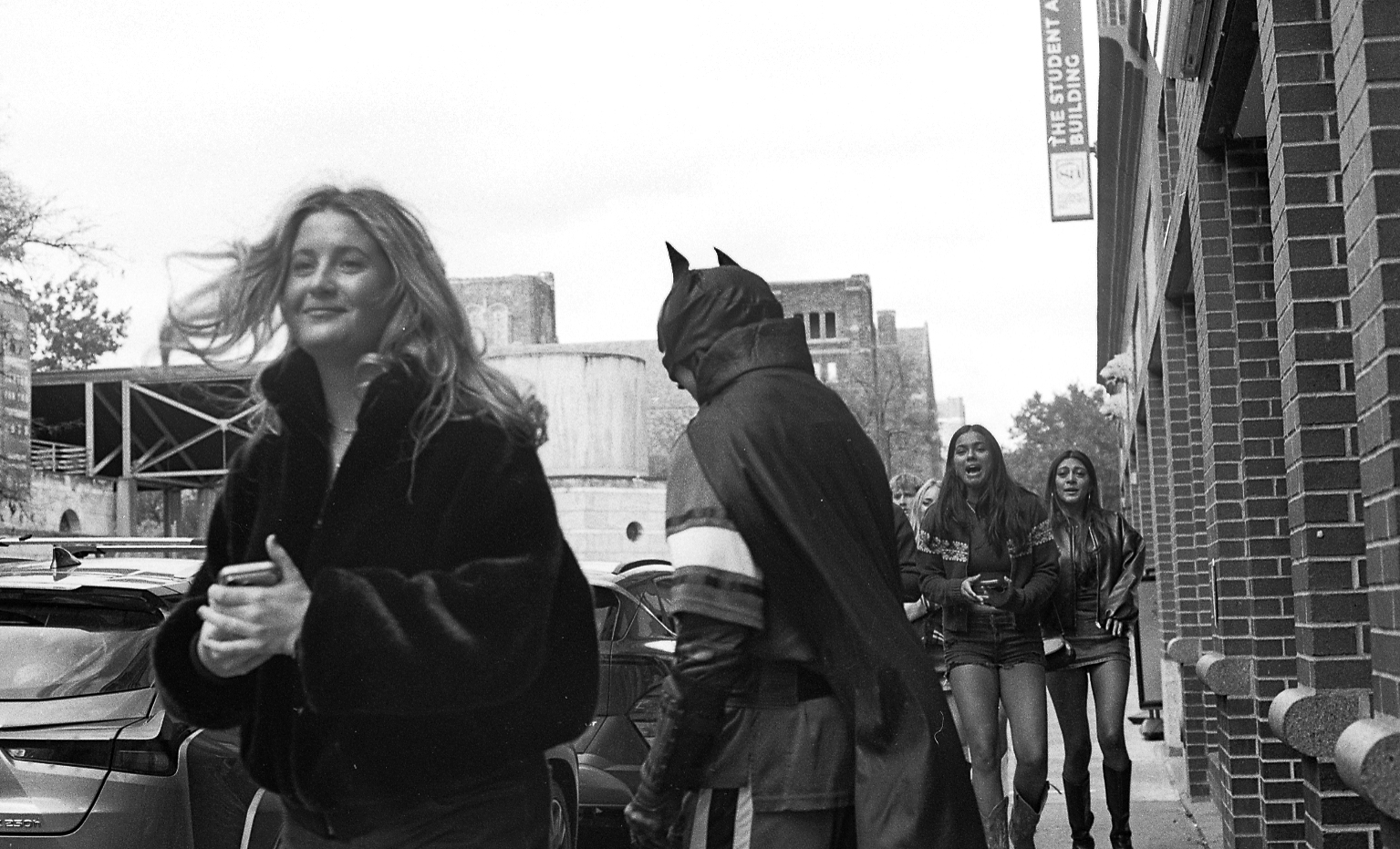
It was a beautiful day in Ithaca. Through the bedroom window, the trees shone bright yellow, ogre green, and ombre red-brown. The sun was bright and the fall breeze was blowing. On the walk through Collegetown to where Batman was crashing at a friend’s place, there was none of the techno or rap music that usually blared on homecoming weekend. With the fraternity parties cancelled in the wake of the controversy, an unusual quiet descended upon Collegetown. Batman emerged from the bathroom. He was ready to get dressed.
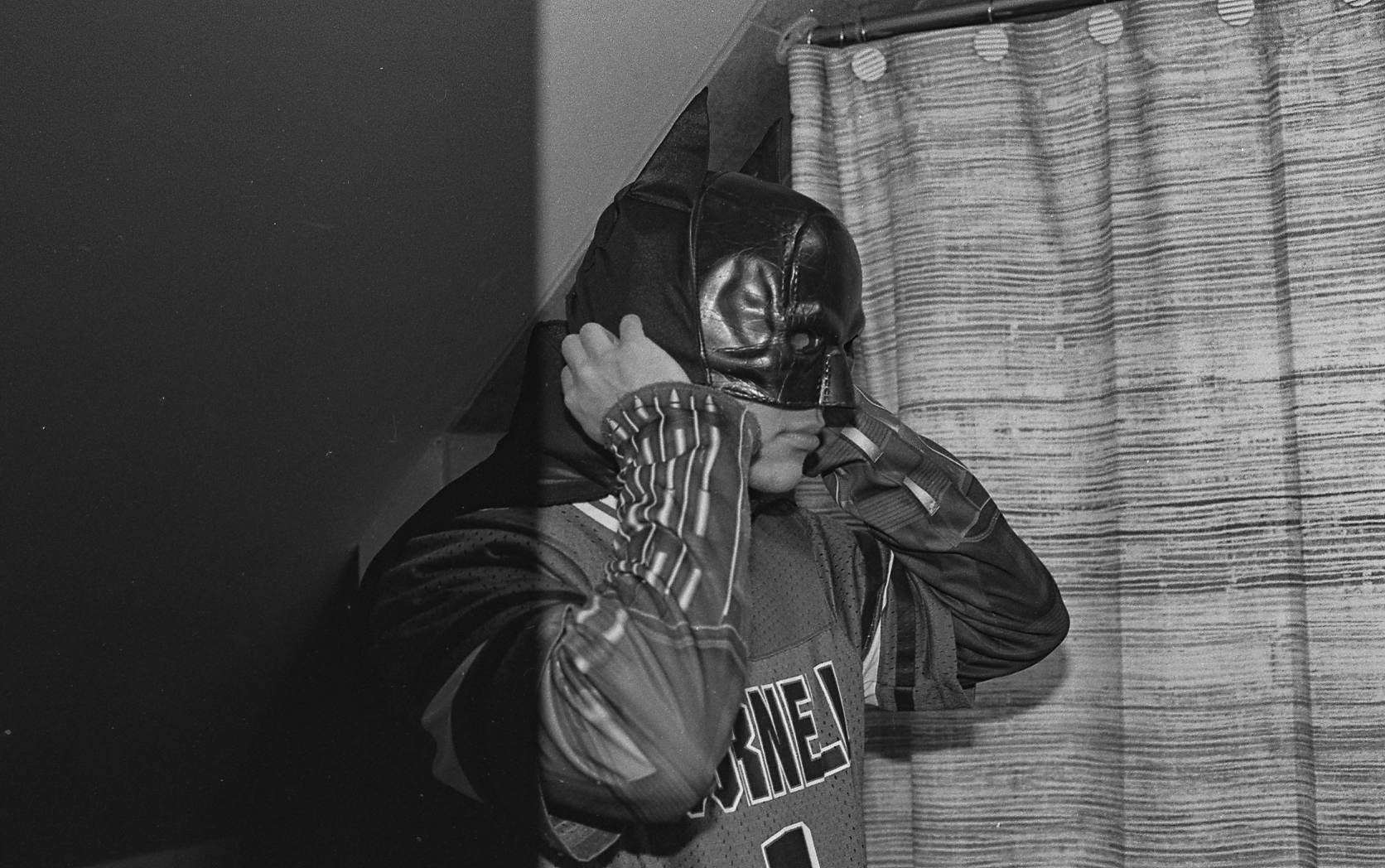
In the bedroom, he stood over his suit, gauntlets, boots, and cape. Then, holding his sports goggles in his hands, Batman let loose a line of saliva that dripped down on the lenses: It helps make them fog-resistant.
Methodically, he layered two pairs of socks, donned winter boots, and slipped into the Party City costume he had first worn four years ago. Then, finally, he attached his cape, which waved as he descended the steps and came out into the light.
“Do you have a phone charger?” he asked.
I did not.
Batman takes his phone with him everywhere he goes and prefers that it's 100 percent charged. “Everyone should have their phones with them wherever they go, especially when they go out,” he said very sternly. “It’s so important. You never know when you’re gonna need it.”
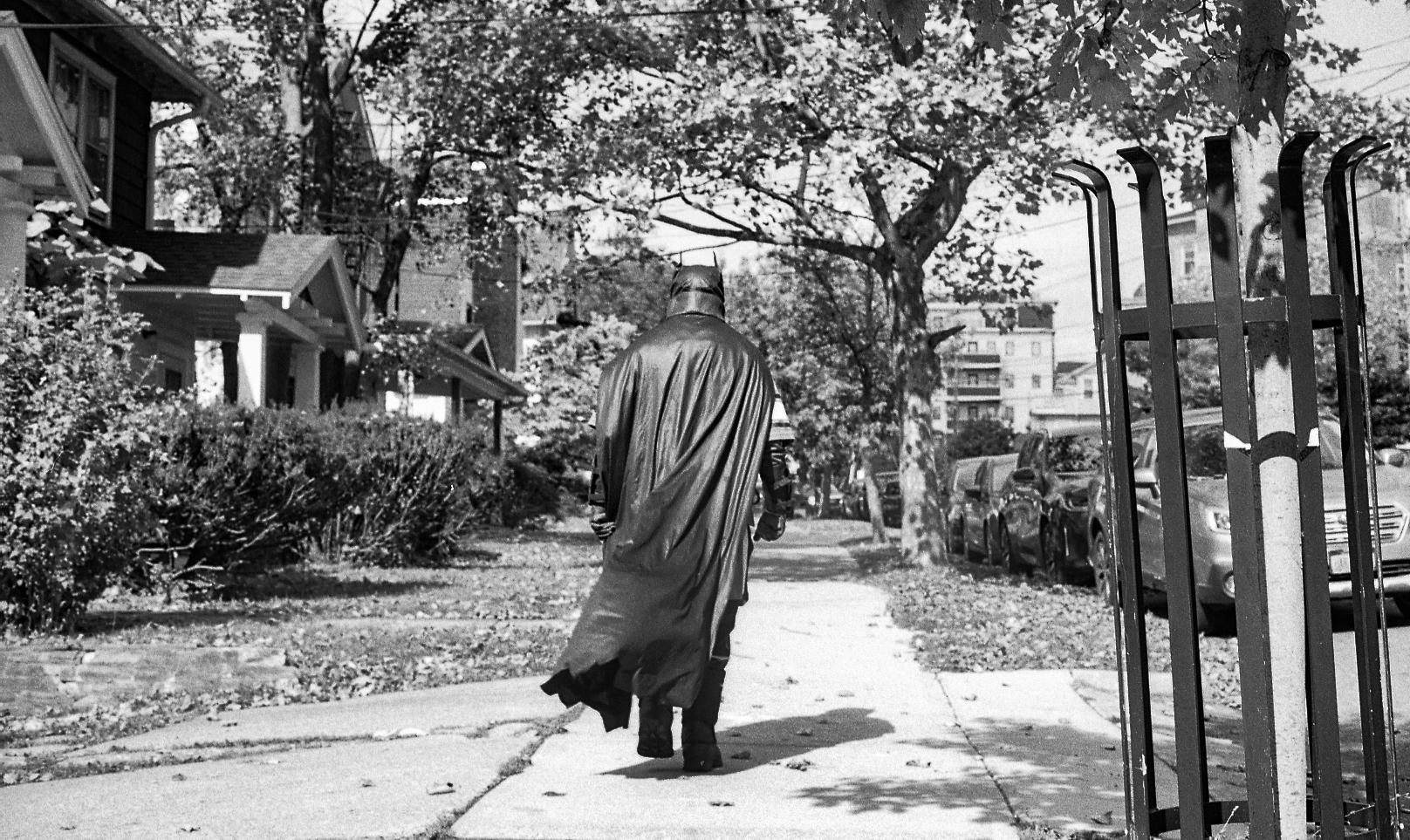
And with that, he turned on the theme music from The Dark Night Rises and set off into Collegetown.
“That’s the same guy!” said the first one’s friend.
“It is the same guy!” acknowledged the first.
“Holy shit!” yelled another.
“Save us please!” a woman shrieked.
“Oh my god, Batman!” exclaimed another.
“Cornell Batman…” a pedestrian admired.
And it went on just like this.
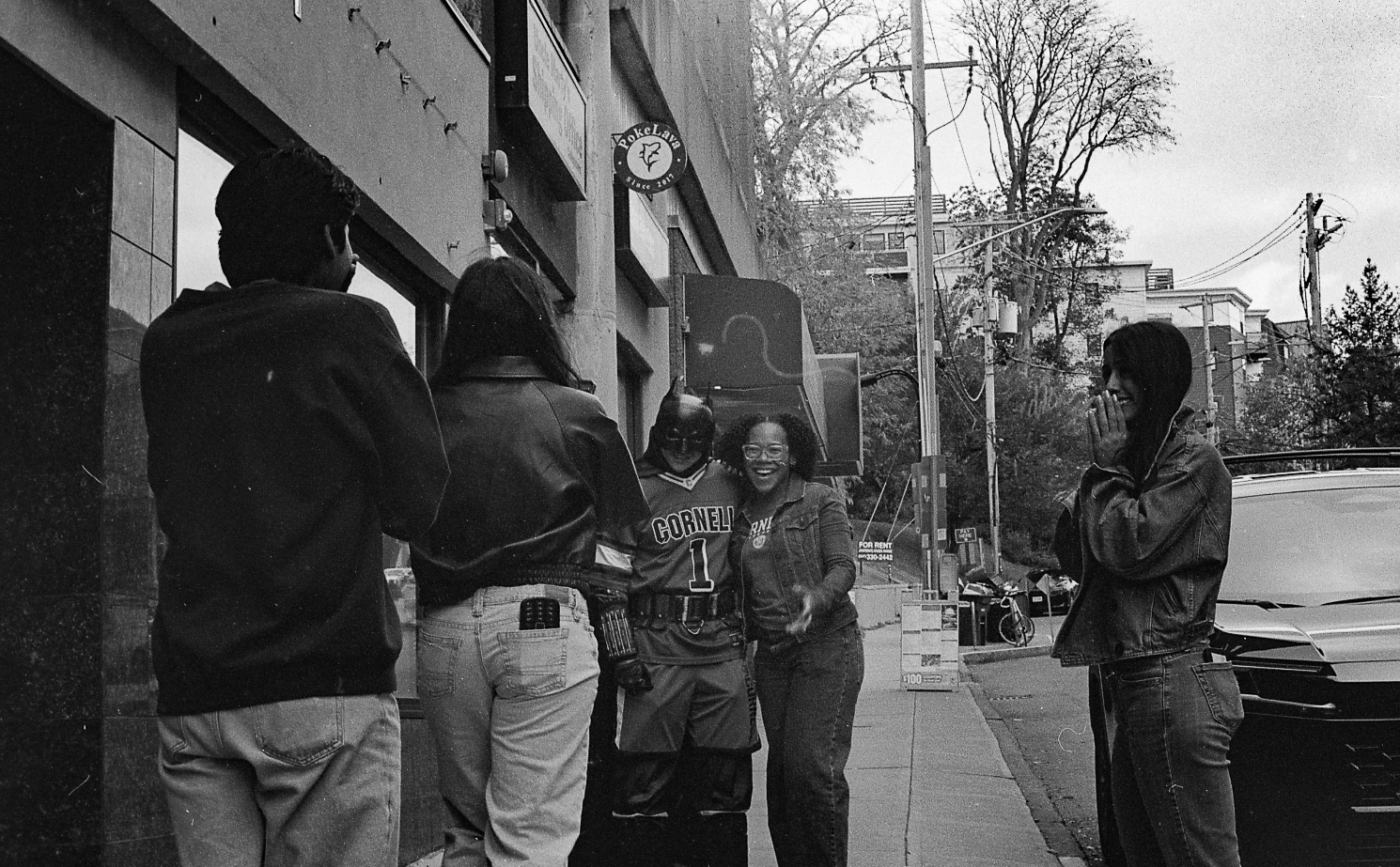
“Batman’s back!”
“Oh, it’s Cornell Batman!”
“Oh shit!”
“Yo, it’s Batman!”
“It’s good to see you again. We missed you!”
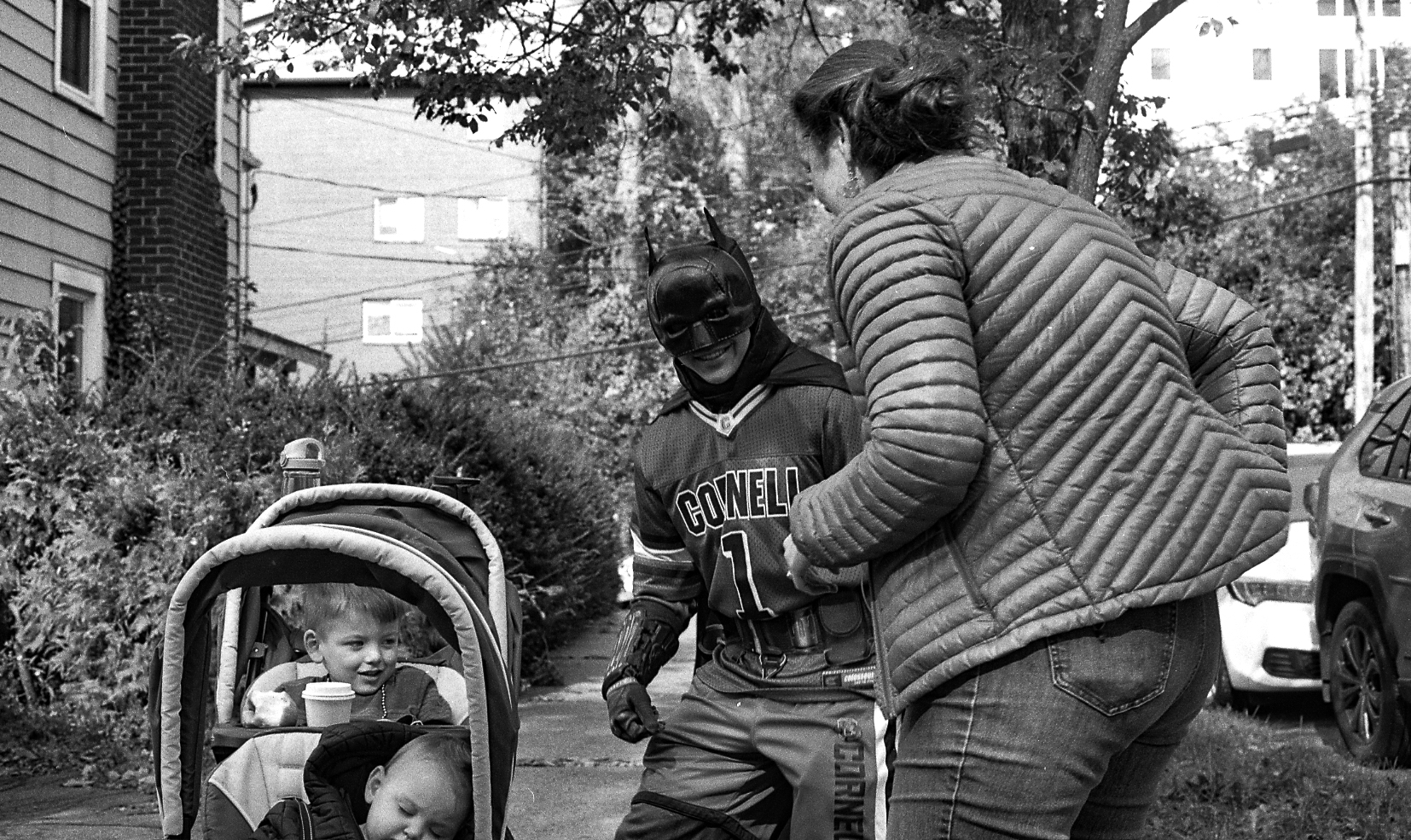
“Batman! Batman! Ohhh my god, can I take a picture?”
“Wait, he’s back? He graduated?”
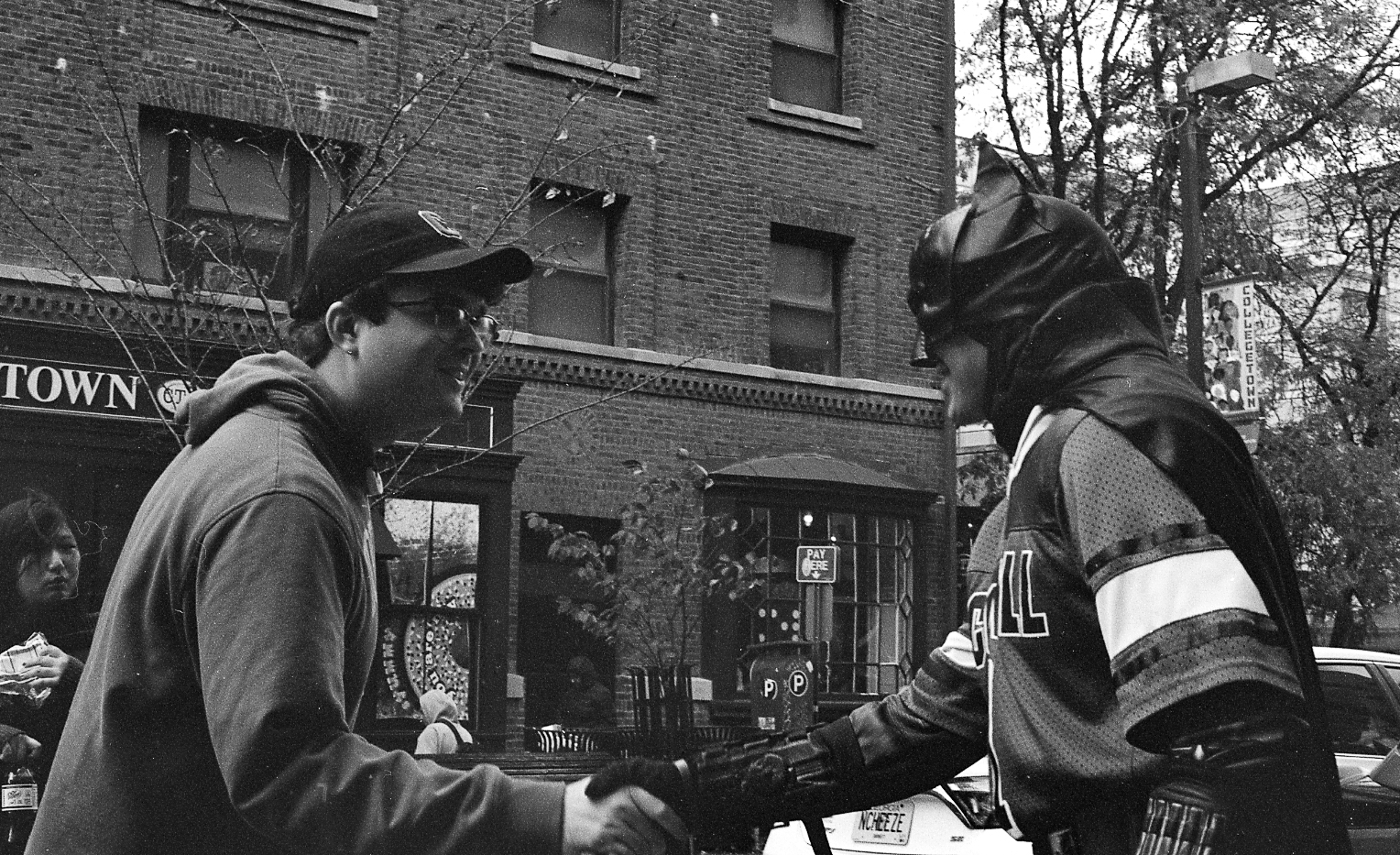
By now, Batman was crossing the street, making his way to Ho Plaza, eyeing the clock tower. For a moment, he looked up into the sky. He put both his hands to his mouth, blew a kiss, and pointed his fingers up into the air. The cape fluttered behind him, the passersby grinned, and the phones came out: Everyone wanted a picture. In his deep growl, he said, “It’s so fucking good to be back.” ♦