Jenny Williams, one of Collegetown Magazine's Creative Writing Editors, sat with Maurice Brown to discuss his new short story “How the Good Days Happen,” which was published this week with Collegetown Magazine.
Williams: The main thing that intrigued me in your story, and I think it's also the main part of the story, is the central relationship between an alien and a human. And I was wondering if you could tell me about that plot choice. What is it about like the relationship between an alien and a human that drives the story?
Brown: I think those are good questions. The reason that theme popped up in this is just because one time I met a friend who asked some strange questions that I didn't expect to just be asked out of the blue. I would try my best to answer them, and it would always be kind of strange, and it felt, in its own way, like, a little alien, because it was a different world of dialogue that I'm not really used to. There's a sense of alien and far out stuff on Earth that'll make you feel that way. So I thought, what better way to portray that than a little green alien man? And that was what I ran with.
Williams: What is it about the relationship between an alien and a human that drives the story?
Brown: Just the idea of oneness, a thing I've been obsessed with recently. No matter where you go, no matter where you're from, or who you meet, any two people, no matter what, can find some way to get along. I'm reading this Hitchhiker's Guide to the Galaxy series, and that's really inspired me, in a way, because those books are all about how everyone likes long lunch breaks, everyone likes three day weekends, no one likes Sundays, 'cause you got work in the morning. No matter where you go in the universe, even if it's fictional, everyone agrees on the same stuff. And that’s what I embody here. Everyone likes a cup of coffee in the morning whether it's sweet, bitter, or whatever. They like the outside and a bright day. No one likes back pain or, you know, whatever it is and goes through. The idea is oneness, how everyone from any place can be best friends.
Williams: Off that point, would you say that sort of the reason for including such a surreal, such a surreal plot with very real issues because in the beginning of the story the main character’s wife has passed away, then you get into this really surreal story. Can you talk about that combination between real hardship and pain and surrealness?
Brown: Everyone goes through things. You can see this idea within the narrative, 'cause it's 1st person, but you get in the main character’s head, and you hear about how his wife passed away abdhis anxiety with the unknown. Grob is in this same kind of way. Even though you're not really told what he goes through on his side of the universe, you know that he does deal with this, and he does want to know how good this happened, so that maybe he can try to figure it out. Ultimately, that because both of their lives have had, you know, it's called how the good things happen. But it's also about how, necessarily, bad things happen too. It's like both characters have had their bad days. I don't know, ultimately, if they could stop them, they could, and maybe this is just another one of, you know, several things that they agree on, and that's what kind of helps them become friends. I like that.
Williams: This is more of a you-question, but what do you think a good day is made of?
Brown: I do agree it's with coffee. Yeah, I mean the end, where it's like, a good day is coffee, something to keep your thumbs busy, and peace, quiet, or maybe your friend. Yeah, and I agree fully. Every day I have my coffee, I make sure, really, that, like, no matter how busy I am, I do something that entertains me, whether it's playing my games for an hour, like, reading my book or whatever. Good company, like, two people at a patio table — that's why I can't wait to have a house, and have company over, and, of course, live with somebody, it'll just be awesome. And it'll be, like, a good day factory.
Williams: The plot is relatively simple, which I enjoyed because I feel like the story was about the simplicities of joy and the simplicities of relationships. These next few questions are a little bit about your writing process. What was your writing process for this story like? What is your reading process typically like? When you write something?
Brown: This is a really fun question for me because while I feel like it always changes with every story, there is something that does remain the same. I find that most stuff that I write comes from such a specific moment. It either comes from maybe a lyric that I heard in the song or maybe a very distinct feeling that can be reduced to a sentence or a sort of phrase or even a line from a book. This story comes from a book I was reading called The American Dreamer, which is a rarity for me because it was nonfiction and I usually don't read nonfiction. There was this line about how the good days can happen whether you're here or, because it's about a soldier, fighting a war, or in other cities. But that part of the line, the part about the good days, clung on to me and it got me thinking about an old man and his little alien friend from a wormhole. And that was it. So, and that's kind of how a lot of my work goes, I find that little line and go from there. I also listen to a lot of music when I write. So part of it also comes from the feeling that the music gives me. I listen to a lot of instrumental hi fi, hip hop stuff and it helps to inspire me to keep a story exciting. I'll write for hours, and I'll kind of forget what other work I have in the day. I'll forget that I am hungry and then before I know it, it'll be like 3 o'clock, 4 o'clock and then I have to move on. But even when I do move on, I'm still living in the work that I've made, and I'm thinking of, like, how I can furnish it, how I can add a character here and there and make, you know, maybe this character should say this line. I just obsess over it for about a week or two. Then once it's done, I show a couple people and go over the whole thing again when I'm editing.
Williams: What is it about the sci-fi genre that you're so drawn to and that you feel inspired to have it in your work?
Brown: Yeah. There's a lot about that. I can't get away from it. I can't get away from sci-fi. I just love it so much. There's something so awesome about sci-fi, where you can take the mundane, and you can make it awesome, you can make it surreal, you can make it very bizarre in all kinds of ways, and then you can do the exact opposite. You can take the bizarre, like an alien coming through a wormhole, and then you can make it typical and that I think is such a magical thing. That’s why I can't stay away from it. I think it just lends itself to so much style and creativity, 'cause you can do anything, you can go anywhere, people can come from any place. The universe is a huge place so it's just such an easy backdrop for anything you can think of. Ultimately, the sci-fi genre knows how ridiculous it really is so I like leaning into that.
Williams: Sci-fi is such an interesting genre to me personally, I mean, I don't write sci-fi and I don't really read sci-fi. But I think it has this really special ability to almost predict the future.
Brown: That was something I forgot to bring up. In sci-fi you can lean more into, like, social commentary, be serious and funny.
Williams: It's such a good medium for social commentary.
Brown: Yeah, because you're looking at issues that are totally represented by real hard things that are in front of you. But because it's sci-fi, maybe you're on the planet Mars, and the people are all green,and they say quirky things and they have their own quirky habits. Because you're in such a novel setting, it invites you to look at things in a different light. Then you can apply that to the real world. And I think that's an awesome thing that is kind of exclusive to a lot of sci-fi.
Maurice Brown on His Short Story "How the Good Days Happen."
Creative Writing Editor Jenny Williams sits with Maurice Brown to discuss his short story, science fiction, and good days.
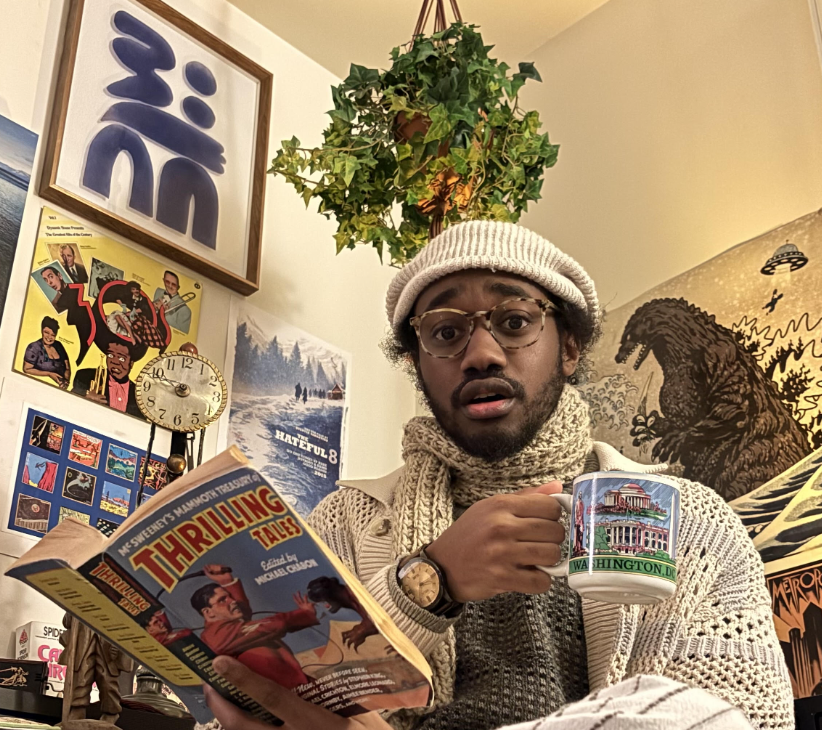
Photograph of Maurice Brown, provided by subject.