
“Loneliness, once a borderline experience usually suffered in certain marginal social conditions like old age, has become an everyday experience of the ever-growing masses of our century.”
Hannah Arendt, 1951
Three weeks ago, I participated in a debate. You may have read about it in the Cornell Daily Sun, which called it “the closest humanity has ever gotten to a period of sustained world peace,” or, if you’re a real freak, in Playboy Magazine, which described the night as “300 curious students packed shoulder-to-shoulder to answer one of life’s most vexing questions.” You may have even been one of the students who crowded Kaufmann Auditorium and made mincemeat of its fire code regulations on the night of February 10th. If so, you’ve heard of the Big Red Moon Club’s debate on one of the great questions of our time: “Is Pegging Gay?”
The pegging debate left its mark on the university to the tune of 22,000 likes and 110,000 shares on its declarative Instagram post. Some of that can be chalked up to its lewd subject matter, but the level of penetration is so deep that there must be something more than immaturity at play. Since the debate, I’ve been stopped for photos, recognized at parties, and called out in classes. In conversation, friends, acquaintances, and strangers marvel at the scale of the spectacle the Big Red Moon Club put on. They often assume that the resources and planning required to mount such an event were far greater than they actually were.
There exists an unwarranted sense that the Big Red Moon Club is an institution with deep roots on campus; it is rumored, even, to be a secret society. Peeling back the curtain on the Pegging Debate reveals something different. Although the group describes itself as an “unofficial moon club and queer society” with an anonymous membership, it is almost exclusively represented by one individual: senior, Surya Nawiana. The Performative Male Contest’s runaway success in September 2025 established the genderfluid Communication student and the Big Red Moon Club as social movers and shakers in Cornell’s co-op-centered queer counterculture.
Surya first broached the subject of a pegging debate to me late last semester, and it was mostly a running joke until the infamous “featuring the Cornell Republicans” Instagram announcement thrust it firmly into reality as the spring semester commenced. At the start of February, Surya told me the debate would take place the following Tuesday, in a room dubiously booked under the auspices of the Cornell International Affairs Society. Then, there was silence. On Thursday, I asked what the plan was, and he told me we’d meet on Saturday to discuss. On Saturday, they texted me and three others that we should meet on Sunday. But all five of us weren’t all free until Monday afternoon; the meeting would have to be then.
On Sunday afternoon, Surya texted, “should the event be at 7 or 8 pm?”
Monday at 4:30 I met my coconspirators; “the illustrious” Linda Fu of the Model United Nations Conference, the epithet-less Hayden Watkins of the Speech and Debate Society, and a participant who has asked to remain anonymous.
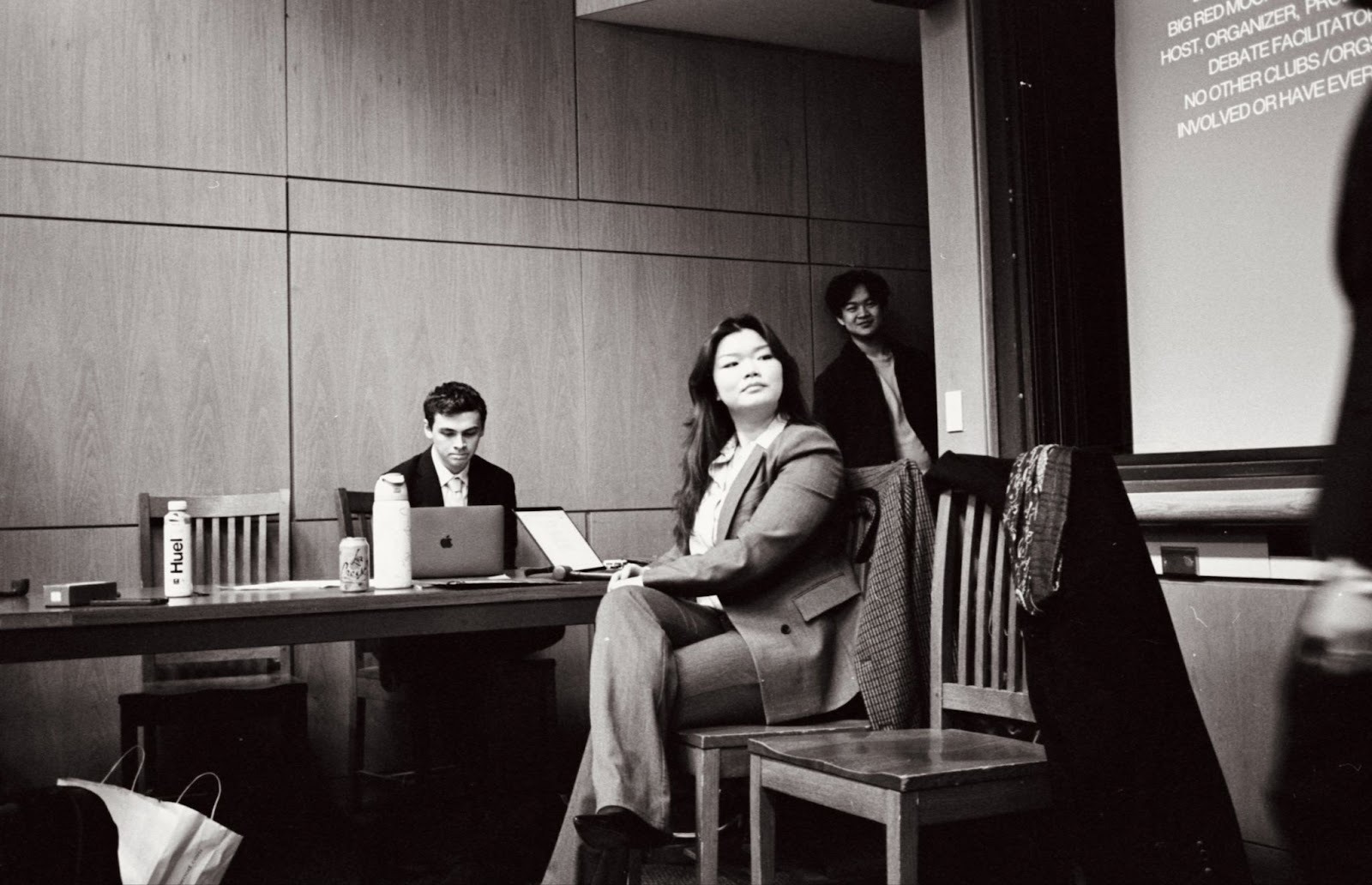
I had expected that Surya would have a debate structure in mind. Instead, when we gathered, he asked what we thought the format should be. Fewer than twenty-seven hours remained before the debate.
“If we do two-v-two, we’ll have someone sub in for one round, so it’s actually like, you know?,” Linda proposed.
“Oh, we have like a bench?,” I asked.
“Yeah, like a bench, yeah,” Linda said.
“So how are we - are we doing, uh, everyone gives one speech and then we…?,” the anonymous debater started.
“We have like a grand cross?,” I said.
“No, I-,” interjected Surya.
“- parliamentary procedure -” Anonymous.
“Lincoln-Douglas, what are we talking about?” Me.
“What I think is we have two debaters for each team, and then the other person, like, is a rebuttal.” Surya.
“Ooh, very formal.” Me.
“So everyone speaks twice?” Anonymous.
“Everyone speaks once.” Surya.
“We should do this like Mock Trial.” Linda.
“We should do this CPU [Cornell Political Union] style!” Me.
This continued for some time.
By the end, we had decided on a three-minute opening speech by one debater from each side, unlimited one-minute rebuttals from the other debater, and a trial-style cross-examination culminating in closing statements and an audience vote.
Reader, in retrospect, the format was a bit unclear.
Either way, soon after the debate began the following evening, the improvisation began too. Our opening statements ran roughshod over the three-minute limit, all four of us spoke and rebutted, and not one of us had remembered to put together a line of questioning for the cross-examination, which Surya hastily announced had been cancelled due to “technical difficulties." In the confusion, I abandoned all hope in my barebones notes and started riffing. All five of us up there were flying by the seat of our pants.
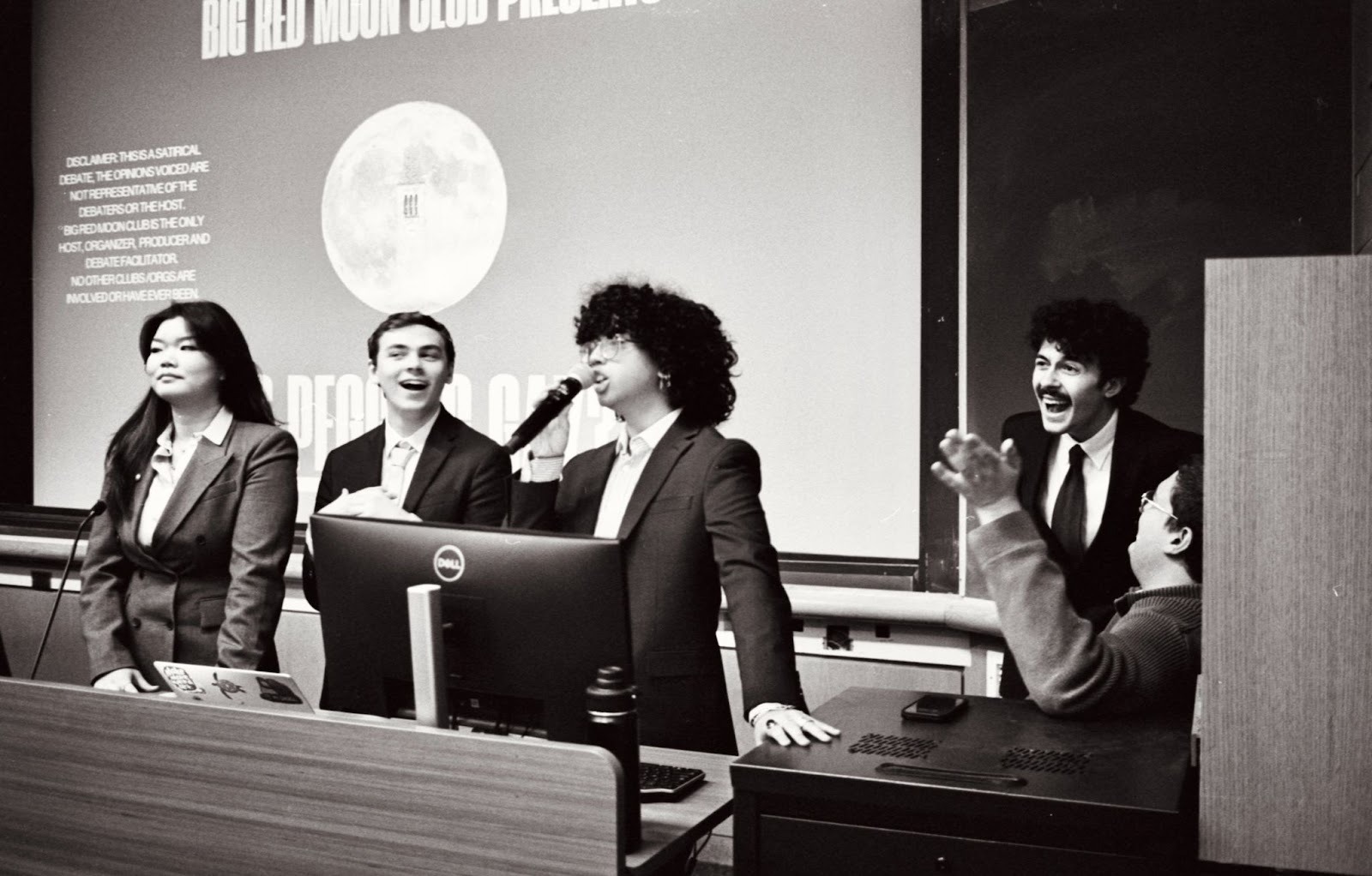
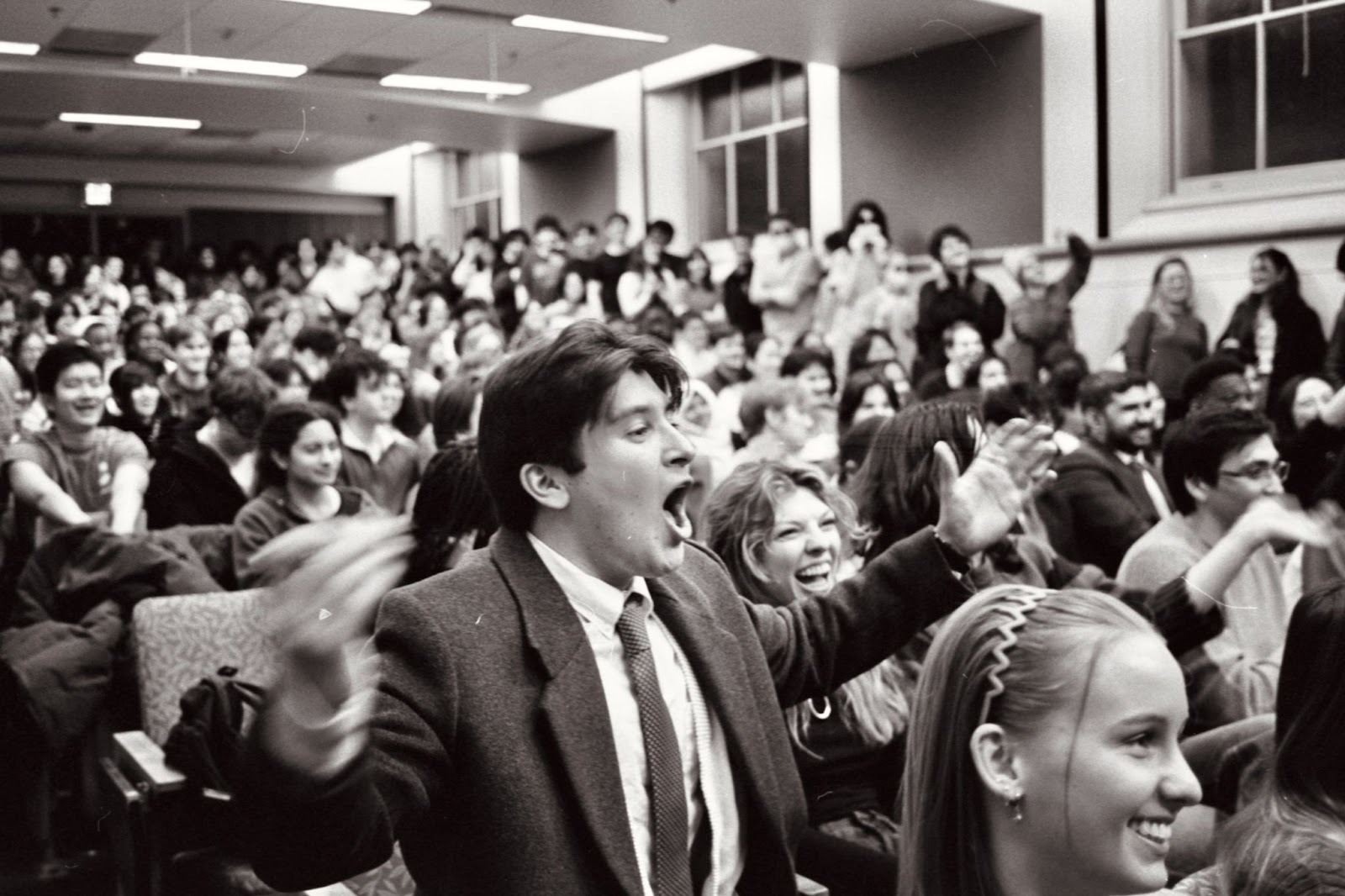
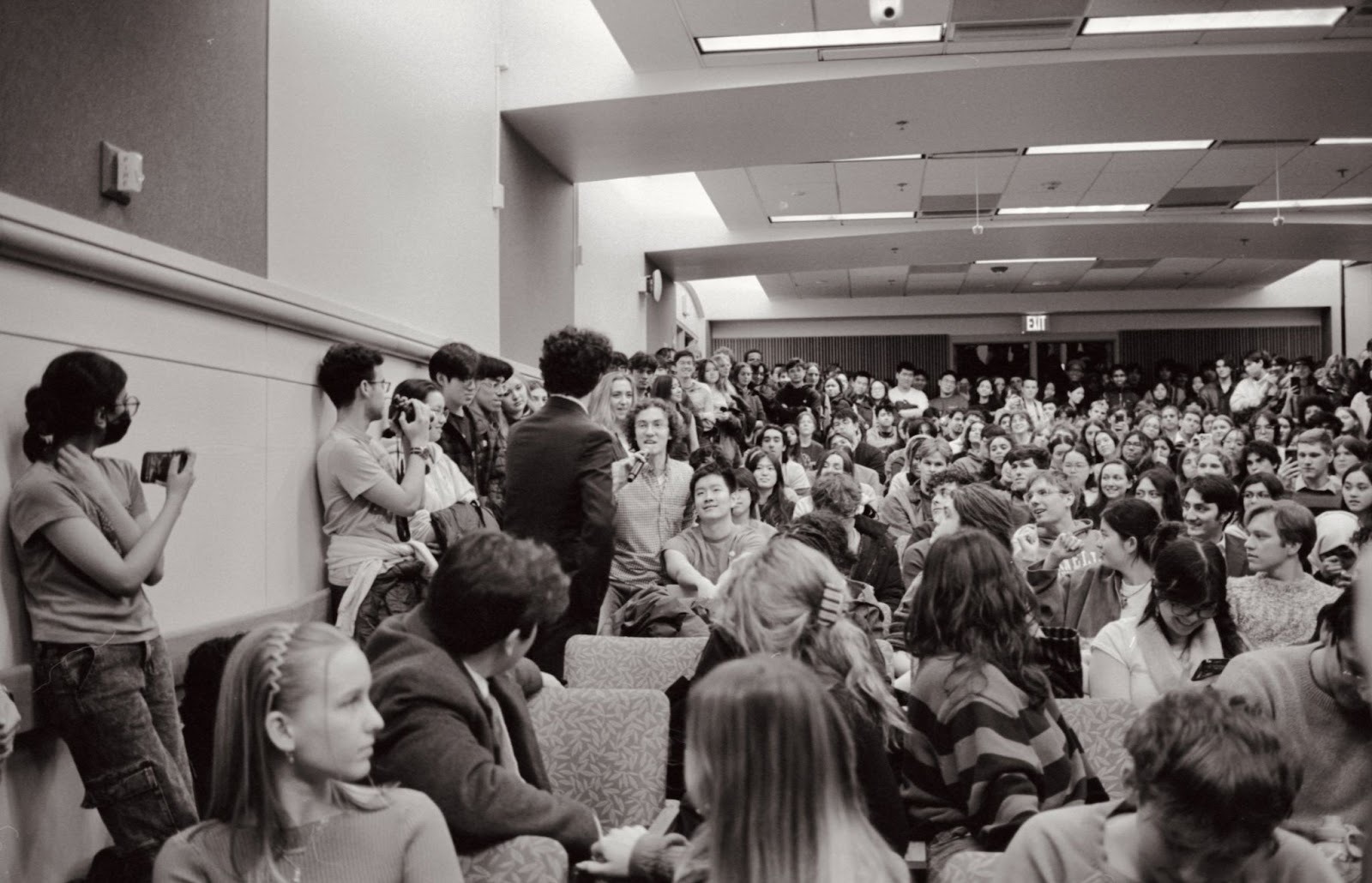
Soon, though, the gods of chaos smiled. We began to create something beautiful. My anonymous companion waxed poetic about the Ottoman Empire’s liberated sexual mores, “until the evil West stigmatized homosexuality.” I accused the ILR School of being “straight, and therefore bad.” An audience member went on a tirade about the failure of Max Weber’s 1905 tract The Protestant Ethic and the “Spirit” of Capitalism to account for the development of capitalism in Italian city-states during the late Renaissance. Hayden unpromptedly asked a woman in the audience how she would feel if her boyfriend asked her to peg him. I interrupted my opponents to loudly dispute their claim that Donald Trump was the first gay president: “James Buchanan did not die in vain!” The crowd, ardent Buchananists, went bananas.
There was a gleeful ridiculousness to the proceedings, and everyone was in on the joke. Half a dozen students Surya referred to as “pre-gynecology majors” arrived in surgical masks, pink scrubs, and sunglasses but too late to find seats, so they stood in a clump in the aisle. In response to a baseless accusation of heterosexuality, I perfunctorily scanned the crowd and announced that I had had sex with multiple men in the room. Two of them, sitting next to each other, guffawed as the crowd roared.
In my closing speech, I tried to introduce a note of profundity.
“Despite the positive allusions that we've tried to make, as I said in my opening statement, pegging is still something that suffers from, frankly, a real stigmata [sic: Sopranos reference]. There's, I think, a sense of hesitation, first of all, that we felt as debaters about debating this. There's a sense of hesitation that you may feel about asking a question or acknowledging your experiences with pegging.”
“That uncomfortability, that sense that pegging is in some sense a taboo experience, is in many ways similar to the very same challenges that gay and queer identities face, “ I said. “But it's also a sign that we are not living in a world in which pegging is uncontroversial and straight. We're just not.”
My anonymous companion had a broader benediction about the significance of the night’s events.
“Folks, before we start our closing statement, I just want us to all take a moment… and appreciate how in regards to current events, we understand that it could be difficult to be openly queer, and I just want to give a big thanks to the Moon Club that they're offering us this space to debate such a queer topic, whether it's gay or not. Thanks to the moon because not everyone in this country has the privilege to be openly queer and feel safe to do so.”
To sum: an organization whose only discernible presence is an Instagram page run by a sassy CALS student threw together a debate that was — barely -– planned the night before. We just made it up. Anyone could have done it. And the result was “perfection — a packed auditorium, passionate deliberations and a powerful sense of community uniting students across campus,” to quote the Sun.
As Surya was wrapping up, Hayden raised his hand. He had one last thing to share.
“Back in my hometown we have a saying. ‘Don't ask, take it up the ass.’”
So, how did this happen? Will it happen again?
There are some indications that the magic of the pegging debate will be fleeting. The most convincing is the integral role of Surya’s personality in bringing the magic of the Big Red Moon Club to life. They are a born self-promoter who understands their brand and has run with it. Who else is making LinkedIn posts about matcha and Labubus? (“#PublicRelations #PerformativeMen #CornellUniversity #DigitalMarketing #CampusCulture #GenZ”)
Daily, she strides into the Temple of Zeus wearing a predictably hip all-black ensemble of embroidered jeans, chalkstripe vest, leather jacket, and enough steel jewelry to give a medieval knight peace of mind. Rare is the denizen of Zeus who has not grown used to watching him roam the marble tables, scanning the crowd through tight curls and wire-rimmed eyeglasses. Their repetitive ensemble is uniform, armor, statement, and personal brand.
There are inexorable social currents at play. Since fall 2024, the Green Dragon Cafe in Sibley Hall, erstwhile home of the Gay Little Monkey Latte, has been closed for renovations. The loss of “A welcoming environment for artists, queer people, fashion statements and chai lovers alike,” may have displaced those groups (all of which Surya belongs to) into the Temple of Zeus instead. Today’s Zeus is an amalgam of the well-groomed daddy’s-money tote bag set, liberal arts academics engrossed in their Balzac, and the newly arrived Dragoons. It is not a coincidence that those three groups were well-represented in the audience at the pegging debate.
Holding court in the Temple, tote bag at his side, Surya impassive face and deadpan tone don’t long obscure their central status within the third group. Her circle is socially associated with the cooperatives, broadly queer in their gender and sexual expression, mostly nonwhite, and counterculturally fashionable. They are at Qahwah House, Collective X, Fanclub, and Watermargin, where Surya is the president. They are proudly, irreverently Bohemian. At the table, Surya steers the conversation with grandiose statements that would push buttons or arouse ire in other contexts, but refrains from crossing lines that would cause issues in their direct circle.
The totally unsubstantiated declaration that the Cornell Republicans would be hosting the debate in concert with the Moon Club—an announcement which sent the CRs into a fury that culminated in my expulsion from their State of the Union watch party a few weeks later—was vintage Surya. The announcement was transgressive in the sense that it inspired rancor, but it only did so in the confines of the Cornell Republicans and their immediate social circle. Instead, the primary effect of the whiff of controversy was to build social capital among the Bohemians, intellectuals, and cafe society types of Zeus. Ire from those out of the loop, not in on the joke, is a point of pride. “THEY don’t want us to be doing this… but we’re doing it anyway!” What’s being chased is simply the exciting feeling that ‘the enemy,’ the conventional, desublimated masses, might not like that behavior.
Real-world interaction with dissent is far less desirable. One early proposal for the pegging debate was to have all the debaters on one side be white, and have all the others be racial minorities. The idea was morally questionable at best. But everyone at the table where it was proposed, firmly inside Surya’s social circle, seemed to savor the thrill of toying with it. It was irrelevant that the group who would take issue with it was far broader than the Cornell Republicans: as far as they were concerned, if others were offended, they were not at the table. They did not factor. After Surya made the suggestion, she grinned at me, silent in my prep sweater and collared shirt, as if to dare me: “Are you?”
The circumstances of college life make it as easy a time as we can hope for to disprove Hannah Arendt’s jeremiad about loneliness. As undergraduates, we are surrounded by friends and peers, places to go, and things to do. Justifications, insofar as one is ever necessary to gather, are myriad. Hundreds of students eagerly jumped at the opportunity when they were given it on February 10th. The easy transformation of enthusiasm into the physical act of attending the pegging debate is evidence that the problem is one of hosting, instead of attending. As the sociologist Priya Parker said last month, “We’re all sort of sitting there being like: I wish I were invited. Host!”
But as we’ve seen, the effort that I saw put into planning and hosting the pegging debate was, frankly, minimal. Surya booked a room, picked four friends to participate, held a 45-minute planning meeting, spread awareness through word of mouth and social media, and made it all up on the spot on the appointed day. It went great. It should be heartening that the labor and preparation required to pull off an event of such numerical and social magnitude was so comparatively low. A less ambitious social endeavor would, as a matter of course, require still less.
Moreover, despite deep concerns about our modern technological age expressed at this university, in this magazine, and by this author, the authentic benefit to social belonging and queer identity that events like the Pegging Debate have produced would not be possible without a strong digital network. Even as social disconnection has become a fact of life, so too has the infrastructure required to connect others on any scale shrunk to stand within the reach of the average person. In this context, the technological forces that enabled one person to assemble the Pegging Debate are genuinely admirable.
In light of Parker’s admonition, and the example of the pegging debate, any would-be host should feel confident. Create a group chat to coordinate trips to Cornell Cinema, or drag your acquaintances down to Qahwah House in Collegetown to try the Adeni Chai. Start a book club. You could even book an auditorium to discuss the profound questions in life — so long as you are prepared to explain the physical characteristics of pegging to your parents.