Mairead Clas & Jenny Williams, Collegetown Magazine's Creative Writing Editors, sat with Smith to discuss her new short story "Sleep Study." Which was recently published in Collegetown magazine.
Mairead: Your story “Sleep Study” traces the dynamic between the natural process of sleep and the complexity of romantic relationships. What was your inspiration for the story, and what was the process of writing it?
Hannah: I get the idea for a story from something that happens to me in my real life. In this case, I actually did have an at-home sleep study test done because my roommate had been saying that I snored really loud and showed me a video of it...
It was really irregular and scary! She told me that I should get it checked out. So I did, and it turned out I don't have sleep apnea. It was nothing at all. But that's where the literal idea came from, because I did actually have those little stickers on me. Then I sort of was thinking about my own life and relationships, and I thought, how could I connect that to the idea of sleeping?
What struck me about sleep apnea is the idea of not being able to breathe in your sleep. It is this thing that should be a basic bodily function and something that should happen without your input, and it's not. That made me think on a more thematic metaphorical level about relationships and when something that should be working for all the right reasons just isn't working. So that's where this idea of Seth and Katherine's relationship came from, where, on paper, it should work really easily. It should be effortless. They have been together for so long; they love each other very much, and there are no problems there. And they have a lot in common. They have everything to talk about. So, they check all the boxes, and still, there's something about it that just doesn't work. So that's how I came up with the idea.
Mairead: Something I found really interesting about the story was how the sleeping habits were a reflection of the relationship dynamic. Talk to me about that.
Hannah: There's this obvious cliche that if you’re heartbroken, you're tossing and turning at night, thinking about what went wrong. I wanted to subvert that. I didn't want Seth to be an insomniac. I wanted him to be a hypersomniac. He sleeps 12, 13, 16 hours, and it's just not enough. I thought that was interesting because he's trying to escape the current reality by falling asleep, and he can sleep for a really long time, but ultimately, he wakes up and he’s not refreshed; it just doesn't work. Running away from the problem isn't gonna solve it.
Mairead: Interesting. A lot of what we learn about their relationship comes through in his dreams, which is a way to show how he's holding onto this relationship.
Hannah: Yeah, absolutely. There’s this dream sequence where he dreams about their wedding and then his teeth fall out and he realizes it's a nightmare and he wakes up. I think that was an important motif. It also comes back at the end where they're at the sleep clinic at the same time and they're having opposite problems where he sleeps too much, and she can't sleep at all. I wanted that to be another nod to the way that they're incompatible even though they tried to make it work. I think just the idea of something that should come easily, not coming easily. That's the main thing that sleep was working as in the story for me.
Jenny: I found your choice to write from the perspective of the man instead of the woman was interesting. As a woman myself who writes, I think that would be difficult for me to write from the perspective of a man. Maybe you could tell us about that choice?
Hannah: It was difficult in a sense, and I sort of wanted to challenge myself to do that, because I also never do that. I almost always write from a self-insert point of view. So I wanted this challenge, and I also thought it would be interesting to write about the intricacies of trying to understand a woman's mental health crisis from a man's point of view. I thought that would kind of be interesting, not that I think he's a bad guy. I don't think he's a bad guy at all. I think he's a good guy. But I think there are some things about his view of her that are kind of typically male, in the sense where he feels like, you know... Why do you want to kill yourself? Why am I not enough for you? Why are you doing this to me? And it's like, well, it's not about you.
I wanted to write from that perspective, because I think—in very loose terms, nothing literal—I've sort of had experience being on both sides of this dynamic: being the one who needs the help and also being the one who is offering it and being pushed away. And I think that the latter, being the person who offers the help and can and is failing to help, in a sense, was more interesting to me to write about. Because you do have these complicated feelings of almost selfishness, I would say, of making it about you. I've done that. I think it's not something only guys can do, but I wanted to just experiment with that in that way. I wanted it to be where you could understand why both of them are acting the way they're acting. And nobody's at fault. Nobody's a villain. It’s just how the chips fell. Because I do think that's real life. I didn't want to write about the end of a relationship where it's like, oh, my ex is evil and terrible, and wronged me, and I hate them forever. Because that's not really how it goes most of the time.
Mairead: I think something we discussed was the way you handled mental health in the story. I thought it was really well done, but it is a heavy subject, as it's not coming from the narrator himself, which is tricky. How did you go about that discussion of mental health in the story?
Hannah: I wanted to be delicate, but I didn't want to dance around it, if that makes sense. Because some people would say, it's so dark, and it's so graphic, but I think it's a reality for a lot of people, and I don't want to shy away from that. I was also trying really hard to make it so that she's not a victim in a sense. I don't want to say you don't feel sorry for her, 'cause, of course, you do, but this is just something that she lives with, and it just is how it is. I wanted it to be morally neutral for one thing, because it is, it's a disease. I did want to be honest about the ways that it makes you treat other people, and how it affects other people, without making it seem like she’s a bad person for it.
There was one passage where I mentioned the times that she would get mean and the times that she would freeze him out, and I wanted to write about that with sympathy, as well, because it is a reality of the situation, and you can't talk about someone's behavior without taking that into account. So, I just wanted to write about it with respect and with honesty, 'cause it's real, and these are real people and real struggles, and I wanted to talk about that in a real way.
Mairead: Overall, what do you want readers to take away from this story?
Hannah: I don't want it to be a sad story. I don't want the message to be that sometimes love just isn't enough. I think the story is more uplifting than that, because you get to see a lot of happy times as well as sad times. What I want most importantly for people to take away is that it's never a waste of time to love somebody and to commit to somebody and have a relationship in your life, even if it does come to an end or if it doesn't work, because it ultimately alters the fabric of who you are. It changes you in a really interesting way that you would never have been otherwise. I think that's always good. Even though it didn't end happily ever after, there's no regret, and there should never be regret when you do have an opportunity to be that close and intimate with someone. It's always a good thing, no matter what.
Hannah Smith Discusses Her Short Story “Sleep Study”
Creative Writing Editors Mairead Clas & Jenny Williams sit with Hannah Smith to discuss her short story, writing process, and how she finds her inspiration as a writer.
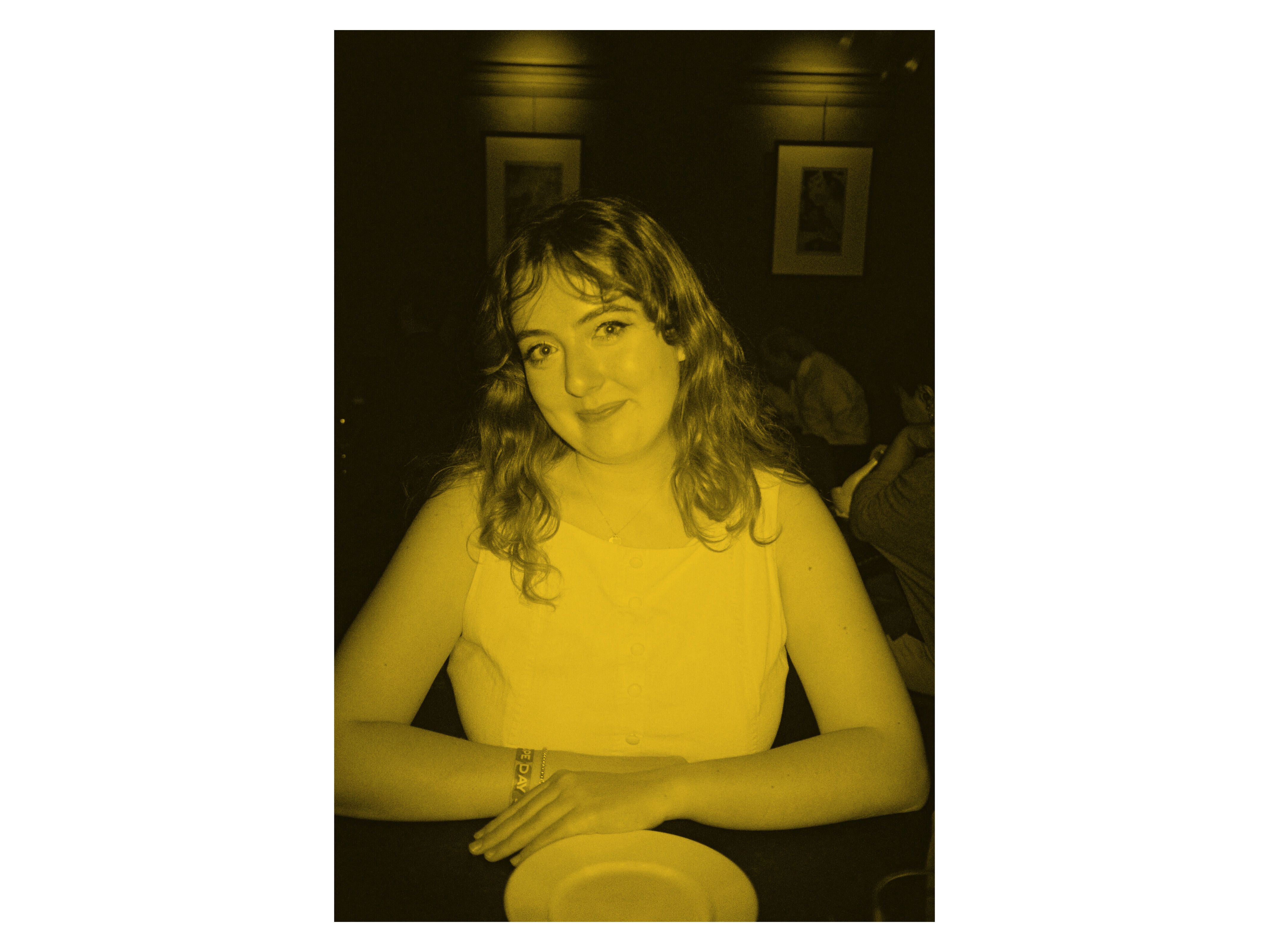
A photograph of Hannah Smith.
Mairead Clas & Jenny Williams are Collegetown Magazine's inaugural Creative Writing Editors. The two are English majors, and are, for some reason, writing theses.