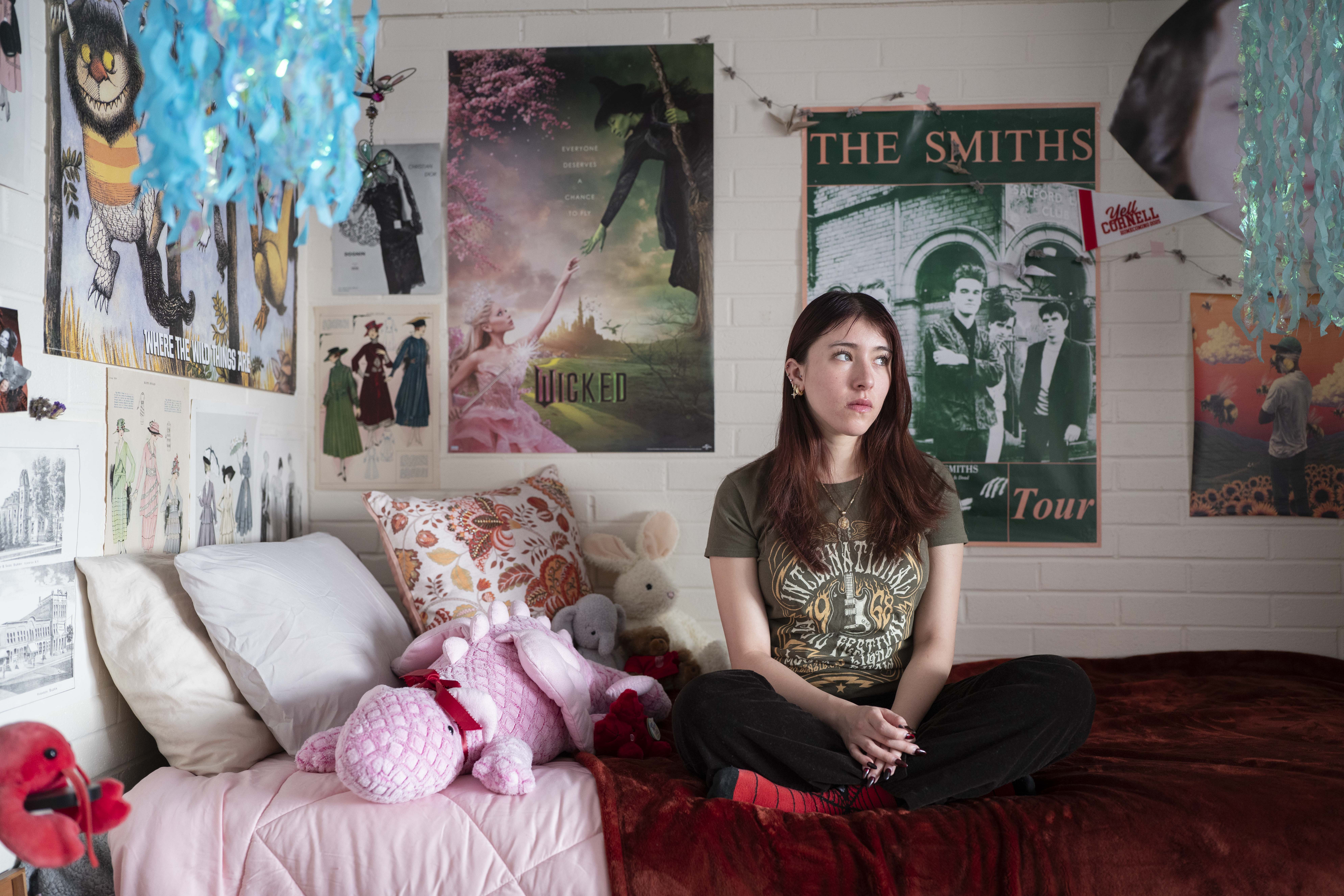
The drive to Adelanto took Klarissa from her family’s home in Santa Ana, California, through about two hours of desert roads that lead to the ICE Processing Center in Adelanto, California—a place Klarissa described as “the middle of nowhere.”
Spools of barbed wire stalk the wall of fences surrounding the perimeter of Adelanto. Klarissa remembers the pain in her stomach the first time she saw the facility, a feeling she described as being shot and throwing up at the same time. “There's no way that my dad is being kept here,” she remembers thinking.

Before driving to Adelanto, Klarissa’s older brother had picked her up from the airport.
“Hey, if you came all the way here to see dad, I'm just letting you know, seeing him in person is not gonna make things better,” he said.
The first time Klarissa visited Adelanto, she was joined by her mother, godmother and aunt. The women joined a procession of families entering the facility for visiting hours. As she entered Adelanto, Klarissa saw another family who had left their visit with a loved one.
“This family came out from their visiting time. It was like someone died… This little girl, like she was probably my sister's age—twelve—she was sobbing so much,” Klarissa said. “That's when I felt it. I was like, ‘Oh my God.’ I was so scared. I was so scared.” The group of families turned silent as the girl sobbed. Klarissa’s godmother, Claudia, went to hold Klarissa’s hand.
Adelanto only allows detainees to see three visitors, three times a week, for one hour a day. For this visit, the women decided Klarissa and her mother, Clara, would see Gabriel. The two gave their IDs—Clara has legal status and Klarissa is an American citizen—to a security guard, who inspected their clothes to ensure they met Adelanto’s dress code. No hoodies, no ripped jeans, and nothing political. During one of her visits to Gabriel, Klarissa’s mother was asked to change for wearing a t-shirt that read “Team Benito,” in reference to the musician Bad Bunny.
Adelanto families need to adapt to the rules if they want to see their loved ones. Touching isn’t allowed, leaning in isn’t allowed, and visitors have to keep both feet on the floor at all times. As visits became routine, Clara befriended other women going to see their husbands. One woman told Clara that she had seen a woman and her baby be removed from a visit after the baby cried too loudly.
A security guard brought Klarissa, Clara and some other families into the visiting room. Klarissa looked around at the staff guarding the detainees. She was dumbfounded; they were, predominantly, racial minorities. “Lots of Black women, lots of Latina women, lots of Latinos working for these people. It's like, why are you here? Like, how much are they paying you to work here?” Klarissa said.
Klarissa took in the room as the families waited for their loved ones. “It kind of looked like a classroom. It was just like white tile, and then a white brick wall.” Klarissa recalls. “Everyone was quiet in the room. Nobody said anything.”
The silence broke when a guard opened a door. For the first time in weeks, Klarissa saw her father. He wasn’t as she had remembered him. He was in a blue jumpsuit with a paper identification tag around his wrist. He was skinnier than she’d ever seen him, and his beard had grown out. None of that mattered to her as she ran to hug him.
“I got up and just darted towards my dad. The guard was telling me ‘Stop!’ but I did not give a fuck, and I just hugged him. I hugged my dad,” Klarissa said. "I wanted to cry so bad, but I couldn't. I didn't want my parents to watch me cry. I didn't want my dad to see that I was worried.”
They ran through the gambit of typical questions parents ask their children when they return from a semester at college. How’s school? How are classes? How was your flight?
Though she was relieved to see him, Klarissa hated having to pretend that her father’s circumstances were normal. “My mom's just talking to him like this is okay, like nothing is going on, and it's just… this is not normal. People having to see their families in this place. My dad being kept there. It’s not normal… What’s going on in this country is not normal.”
Every time she went to visit her father, she couldn’t shake the same thought.
“He's not supposed to be there, you know?” Klarissa said. “He's not supposed to be there.”
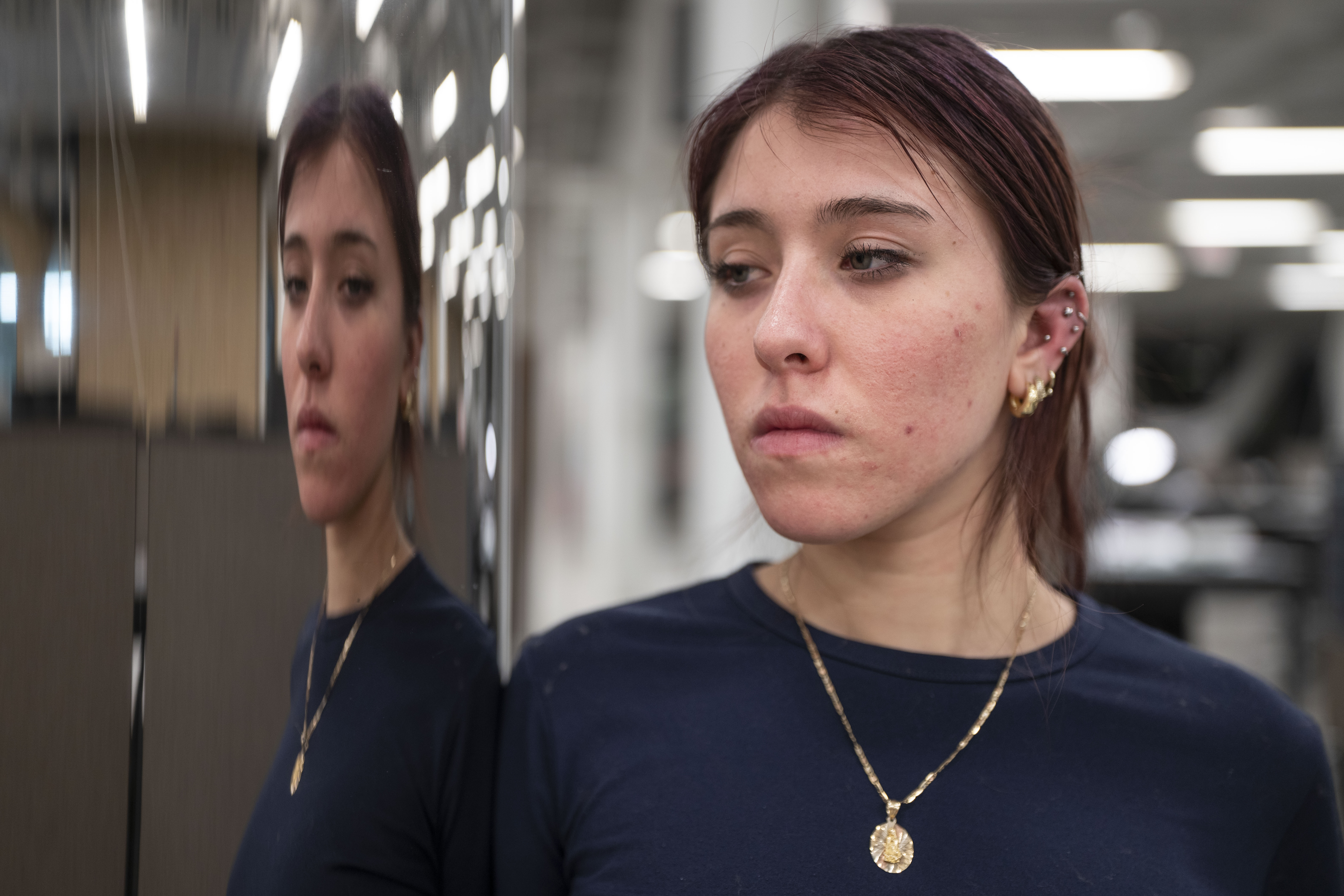
Klarissa says that her father was denied healthcare at Adelanto, something that scared her. Gabriel has ocular problems. He previously had surgery on his eyelids because they drooped so low he needed to lift them up to see. The surgery allowed Gabriel to see, but he needed special eyedrops and prescription glasses afterwards.
The López Guillen family tried to send Gabriel his glasses and eyedrops, but they never arrived.
“They took the glasses, and we don't even know where they went. Every single person, every time we would go, every person would be like, ‘Oh, you left glasses here? What glasses? They're not in here. Who did you speak to?’ Are you fucking kidding me? Like, are you serious? You guys are supposedly federal agents. And it's like they lost my dad's glasses. We don't know where the fuck they took them.”
Adelanto ICE Processing Center is currently being sued in federal court by detainees who allege inhumane conditions. The legal complaint claims that detainees' medical issues are severely neglected.
“One detained individual had the top of his finger bitten off and developed an infection that went untreated. Another has inconsistent access to his epilepsy medication, and regularly experiences seizures that receive delayed medical attention or none at all,” the lawsuit reads. “Detained individuals with disabilities are left to fend for themselves. Elderly detained individuals with mobility issues are forced to sleep on top bunks despite their difficulty climbing up ladders.”
Klarissa visited her father as many times as she could that February before she had to return to school. Following the payment of a $15,000 bond, Gabriel was released from Adelanto ICE Processing Center. He is currently seeking to stay in the United States through the immigration court system. Since his release, Gabriel has been legally unable to work as he does not have a work permit and doing so would jeopardize his legal case to stay in the United States.
In the video, bystanders shout at ICE agents as they push Gabriel into a vehicle.
“Where’s your warrant? Where’s your warrant!” One woman yells as ICE agents push Gabriel into a car. “Don’t you guys have fucking families. Is this what you do?” She continues.
“You can’t do that! You just fucking kidnapped him.” A man yells.
When Klarissa heard of her father’s detainment, she was surrounded by students at one of Cornell’s cafes, Temple of Zeus. Klarissa and her friends had spent a good chunk of their freshman year finding the best spot for matcha on campus, and had settled on a honey matcha at Zeus. Klarissa would send her parents pictures of the drinks she’d get.
“It'd be funny to send a picture of my first matcha of the semester to my parents 'cause I love it. And my dad, he always told me, like: ‘Don't be drinking that stuff. It's too much sugar, and you're gonna, you're gonna get sick if you drink so much of that sugary stuff.’”
This time, Klarissa sent a picture and received a text back from her mother immediately. Then another. Then another—repeating the same thing: Call me.
“I call her, and I'm like: ‘Hello? Like, are you, are you okay… You’re scaring me, mom.” Klarissa recalled.
"They took him," her mother said, sobbing.
"Who?" Klarissa asked.
"They took your dad!”
Klarissa’s stomach dropped. She asked her mother frantic questions. Growing up in Santa Ana, deportation and La Migra—the Spanish slang term for immigration enforcement officials—were facts of life, but Klarissa never thought that her father would be one of the immigrants captured in ICE’s net.
After President Donald Trump was elected for his second presidential term, Gabriel and Clara sat Klarissa and her two little sisters—Annabel, 11, and Sophia, 8—down to discuss what the election meant for their family. At a family dinner, over plates of menudo, Clara spelled the plan out to Klarissa in case her father was detained by ICE. “You're gonna take care of yourself at Cornell,” her mother told her. “‘Me and your sisters are gonna go to Mexico.’” Klarissa recalls, “I just started crying so much 'cause dude, this is your own parents telling you that ICE is gonna take them away from you.”
Klarissa rushed outside of the cafe and into the marble hallway of Goldwin Smith Hall. She checked the location of her father’s phone. Maybe it could give her some clues as to where he was. It didn’t. Clara told her daughter that people on the scene had seen the agents throw Gabriel’s phone and wallet into some bushes.
“I fell to my knees. I got sick to my stomach. I literally thought my stomach exploded. I start literally wailing. Like, I'm like: ‘Oh, my God!’ I cannot begin to describe the emotion I felt. Despair, or anguish, or sadness, or anger. It was something,” Klarissa said. “She [Clara] just starts crying even more, and then I start crying, and then I'm bawling. I'm on the floor just, like, crying.”
Distinctly, Klarissa remembers a group of business students in suits standing in the hallway outside the cafe as she laid on the floor sobbing. One of them, a young woman, walked up to Klarissa.
“Are you okay?” She asked.
“Yeah!” Klarissa said, attempting to convince the student, and maybe herself. “I start, like, walking off into the hallway… walking with the phone in my ear… I’m like Mom, what are you talking about? Who did they take? Kind of haciéndome la mensa, you know, just, like, not wanting to accept it.”
In the weeks following her father’s detainment by ICE, Klarissa’s life at Cornell began to fall into disarray. Klarissa came to Cornell to study architecture in the vein of her Tío Valentín, an internationally respected architect. Now she was too depressed to attend class.

Before he was detained, Gabriel López made about a hundred thousand dollars a year as a construction foreman. Klarissa’s mother made less than half that working for an elementary school. When Klarissa was admitted to Cornell, the university offered her a financial aid package of about $75,000 a year. The total cost to attend Cornell, including tuition, food, housing and other fees is about $99,734 a year. Klarissa paid for her first semester with about $10,000 in scholarships she had earned during her senior year of high school. Her father pledged to cover the thousands she still had to pay in the spring.
Following his release from ICE custody, Gabriel has been legally unable to work. Klarissa's family is struggling to figure out how they are going to afford the middle class American life Clara and Gabriel spent almost three decades building.
“We're probably gonna sell my car. It makes sense. I'm not there right now. I'm here most of the year. So it's like, I can't even be upset about it, you know?” Klarissa said, straight-faced. The mortgage on the López Guillen family’s home is also a stressor; the family has considered selling their home and downsizing since Gabriel’s detainment. The López Guillen family is also on track to lose their health insurance provided by Gabriel’s former employer.
Klarissa currently works as a receptionist for Cornell’s School of Continuing Education. She makes $16 an hour. Following her father’s detainment, Klarissa has had to take up extra shifts, forcing her to drop an Urban Studies class.
“It just sucks, having to put a halt in my studies and stuff to work more.” Klarissa said. “I'm still considering getting another job.”
Klarissa recalls a conversation she had with a university official when she was applying for emergency funding.
“I told her about my story, and she said ‘You know, you can take student leave and stay one semester with your mom.’” Despite her love for her family, Klarissa felt that she couldn’t take a semester away from university. “Being first generation, I don't have the privilege to be sitting around and sulking,” Klarissa said.
Though Cornell paid for Klarissa’s flights home, she still faces a seemingly insurmountable barrier. To stay enrolled at Cornell, Klarissa needs to pay $12,354.18 which her current financial aid does not cover. Klarissa’s mother does not want her daughter to take out loans for her education.
Cornell’s financial aid website states that for students seeking to appeal for further financial aid, that a “significant change to your family situation,” such as the “Incarceration of a parent,” is grounds for a special circumstances appeal.
Klarissa thought that her father’s detainment by ICE, and subsequent legal inability to work—which removed her family’s primary breadwinner—would meet the criteria for an adjustment to her financial aid. Klarissa met with Cornell’s Office of Financial Aid following her father’s detainment in January.
“My future at Cornell is at risk if the institution fails to provide me with more financial support, since my mother cannot help me on her own. I am in need of your help,” reads an email Klarissa sent a Cornell financial aid official in February, following her first in-person appointment with the office.
About a month later, Klarissa had her response from the university.
“Thank you so much for your patience while we carefully reviewed your situation. Our leadership team took time to thoroughly consider the information you shared and review it alongside our institutional and federal policies,” an email from a financial aid official reads. “Unfortunately, our policies do not allow us to make adjustments to financial aid based on current circumstances during this academic year. At this time, our office is unable to review or consider income changes that occurred in 2026 until the review period opens in June or July.”
The email continued.
“However, we will be able to evaluate the impacts of your father’s deportation for the 2026–2027 academic year once that review process becomes available. At that time, you are welcome to submit documentation and request a reevaluation of your financial aid eligibility.”
As she cannot receive adjusted financial aid for this semester, Klarissa is considering dropping out of Cornell.
“Where do you want me to get, like, $12,000 from?” Klarissa said. “They just took my fucking dad, and you're worried about your money. Are you kidding me?”
Klarissa was born in the United States, but that didn’t stop the roots of Michoacán, a Mexican state where her parents grew up from coloring her upbringing.
“Everyone from Santa Ana is from Michoacán. Everybody knows each other. I'd be at the grocery store and some random person would be like… ‘Whose kid are you?’” Klarissa said, laughing. “I'd be like, ‘Oh, de Clara y Gabriel.’ They're like, ‘Oh! Her and I go way back. Your dad and I used to be best friends!’”
Gabriel and Clara grew up in Michoacán’s farm country. Clara is often called a güerita, the Mexican slang term for a woman with light skin and blonde hair. Gabriel, on the other hand, has dark hair and brown skin. Klarissa’s parents met as teenagers at a party.
“She went out with my Tía Yolanda, and one of my dad's friends approached my mom, and he's like, ‘Gabriel quiere bailar contigo.’” Klarissa grins as she tells this story. “And she’s like, "You know, if Gabriel wants to come dance with me, he has to tell me himself that he wants to come dance with me.’” So, Gabriel went over and asked. A few years after they first danced with one another, the two would be in the United States of America, married with children. It has now been over two decades since they moved.
Clara first crossed into the US with her father, Arturo, when she was around 10 or 11. Arturo was a manual laborer who crossed between the United States and Mexico routinely for farm work, sending money back to his family.
“My grandpa was pretty light-skinned. He has the biggest, bluest eyes you'll ever see in your life. So the way [Clara] tells it, she says someone drove them… then they were at the border, and then they just crossed through the gate, that's literally how she tells the story.” According to Klarissa, Clara thinks it was her physical attributes. “She's like, ‘It’s because we were privileged enough to, like, be white-passing, you know?’”
One border story Klarissa perhaps will never know is that of her father’s.
“There are multiple ways in how these people cross. Like for my mom, she just crossed through a gate. She called it a day. Obviously it's probably more complex than that… But that's how she tells it. But my dad, I asked him this one time, and literally all he said was, ‘Oh, you do not wanna know.’” Klarissa explained. “He said ‘Where do I even start? How do I begin to explain? That's…that's too much for you. It's too complicated.’ And literally we never spoke about it again.”
When Klarissa continued to ask about her father’s bordercrossing, “My mom had to say, I think she was like, ‘No, no le preguntes…there's a reason he doesn't tell you.’”
What Klarissa does know is that Gabriel crossed at 18, by himself. He stayed with his uncle and got to work immediately. He has been in the US for 25 years, his entire adult life.
Klarissa, when experiencing the stresses of American high school, would incredulously ask her parents why they had left Mexico if it seemed, from their stories, that they loved it so much.
“There's like nothing out there. The most school you do is middle school,” Klarissa’s mother would reply. “There’s no opportunity out there. The life you have here, you would never have over there. There's so much opportunity here." Klarissa attends an Ivy League school. Her father, Gabriel, stopped his education after middle school. Clara attended some college, but never finished her degree.
Klarissa appreciates her American opportunities. “I feel like if you grow up in a tiny little ranchito like there, and you have big dreams of going to college, it's super difficult. If I would've grown up in Mexico, the way my parents grew up, I would not be here right now.”
As bills pile up following Gabriel's detainment, the life Klarissa’s parents have worked so hard to give her is falling apart.
“I don't know. I guess we're trying to move on, slowly,” Klarissa said. “It fucking sucks… But I mean, people voted for this.”

Since the publication of this article Klarissa has created a GoFundMe.
Editor’s Note: This article has been edited to better reflect the timeline of Gabriel Lopez’s detainment and release by U.S. Immigration and Customs Enforcement officials.